
The Bargain Sarpedon Makes
Theodoros Kafantaris
Published on October 12, 2026
The Scene
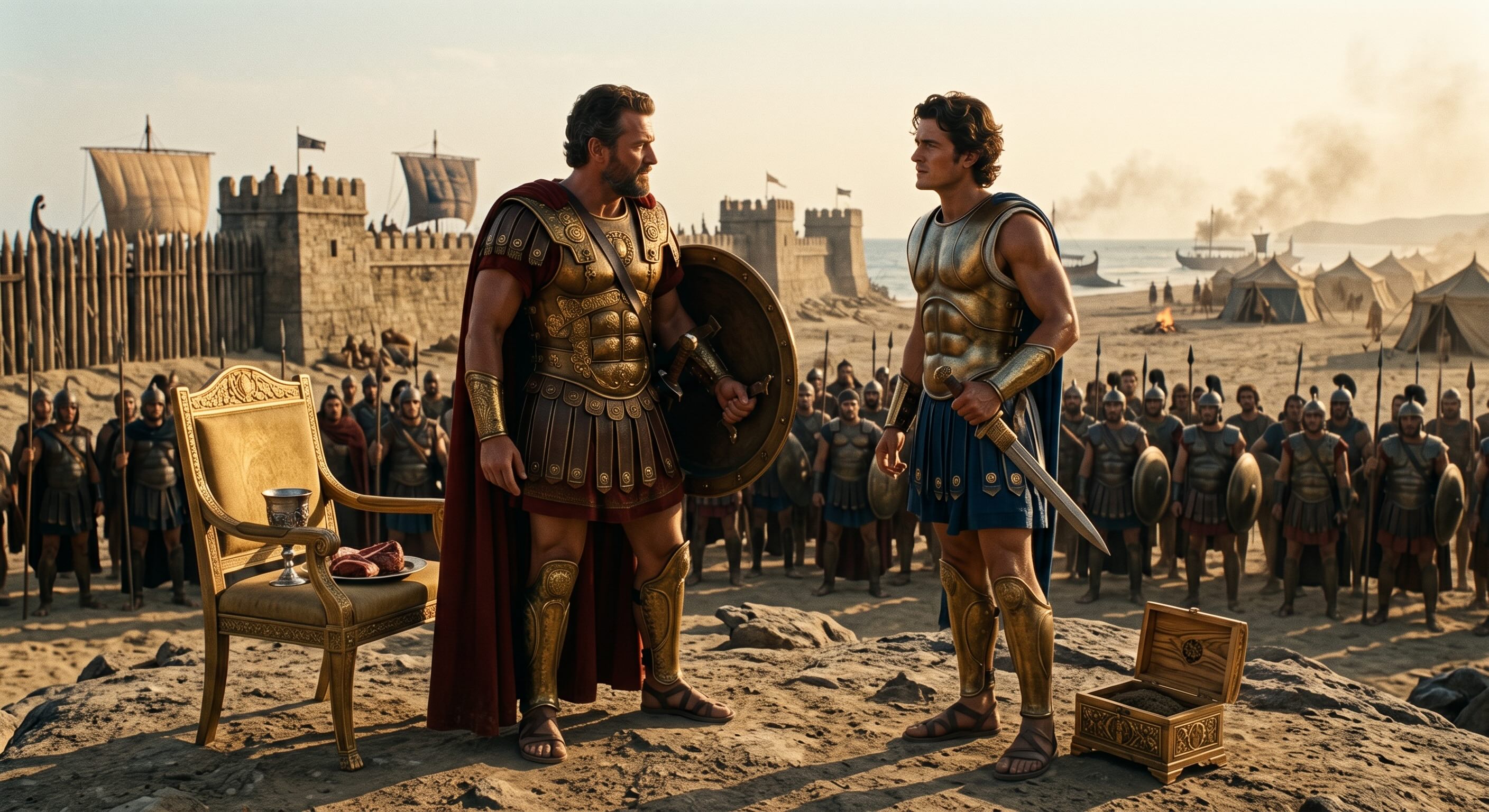
Before one of the war's most dangerous assaults — storming the wall the Greeks have built around their ships — a Lycian ally of Troy named Sarpedon turns to his companion Glaukos and asks him something unusual for a man about to risk his life: why, exactly, do the two of them get the best seats at every feast back home? Why the finest cuts of meat, the fullest wine cups, land on the riverbank that the whole community singles out for them?
It's not idle chatter. Sarpedon is building an argument. Since their people honor them like gods, he says, they in turn owe their people something: they have to fight in the front ranks, so that when the men of Lycia look at them they can say these are no weak men who rule over us.
And then he says the part that matters. If the two of them could somehow dodge this one battle and live forever, untouched by old age, he admits he wouldn't fight in the front line himself, and he wouldn't send Glaukos there either.
But since ten thousand fates of death stand over every mortal regardless, and no one escapes them, we may as well go forward — and either win glory for ourselves, or hand it to someone else.
Then they walk into the assault together.
The Mechanism
Strip away the poetry and Sarpedon is describing a transaction. In this world, there's nothing meaningful waiting on the other side of death — no reward, no reunion, nothing worth looking forward to. So the only currency that survives you is kleos: being sung about, being remembered.
And the best seat at the feast, the choice cut of meat, the land by the river — those aren't gifts. They're an advance. Society pays its heroes in status now, on credit, against the debt that comes due on the battlefield later.
That reframes what looks like recklessness as something closer to a cold calculation. Nobody in Sarpedon's world gets the option of simply not dying. The years were never actually his to bank. So the only real variable left is whether those years buy him a name that outlasts him. Once you accept the premise — guaranteed death, no exceptions — trading a slightly longer anonymous life for a permanently remembered one stops looking like bravado and starts looking like the only rational trade on the table.
The Mirror
Look at who takes the biggest, most public risks today, and you'll notice they're rarely the people with the least to lose. They're often the ones who already have the best seat at the table.
-
The founder who's already wealthy, walking away from a stable company to chase something that could define them or destroy them.
-
The surgeon who takes the case nobody else will touch.
-
The astronaut, the free soloist, the artist who spends a decade on the one book that might be the one people remember.
The privilege came first. The risk is what they feel obligated to trade for it.
But there's a cheaper, hollowed-out version of the same instinct running underneath most of the internet, and it's worth being honest about the difference. A huge amount of what gets called "personal branding" or "building a legacy" is an attempt to collect kleos — to be known, to be seen as significant — without ever placing Sarpedon's actual wager.
The old bargain required something irreversible: you don't get the song without the battlefield. The modern version often asks for nothing but attention and consistency, which is one reason it can rack up huge numbers and still feel weightless.
Even Elon Musk's rockets and Bezos's clock inside a mountain read as this instinct at industrial scale — buying the modern equivalent of eternal remembrance with capital instead of blood, precisely because the old currency isn't available to them either. Sarpedon's logic assumed the two things always traveled together: you only get remembered in proportion to what you actually risked. Whenever they come apart — fame with no wager behind it — something in us seems to notice, even when we can't quite say what's missing.
Read the series: ← Previous: The Wrath Economy · Next: The Catalogue of Ships → · All 10 posts
Post 3 of 10 in Homer Iliad


