
The First Modern Novel: Why You Must Read Don Quixote
Theodoros Kafantaris
Published on December 09, 2025
1. Introduction
If you have ever used the phrase "tilting at windmills" or described someone as "quixotic," you have Miguel de Cervantes to thank. Published in two parts (1605 and 1615), Don Quixote is widely considered the first modern novel and, by many accounts, the greatest work of fiction ever written.
But don’t let that intimidate you. At its heart, this isn't a dusty, academic tome—it is a hilarious, tragic, and deeply human road-trip story. It is a satire of the superhero stories of its day (chivalric romances) that accidentally invented the template for Western literature. Whether you are looking for slapstick comedy or a profound meditation on the nature of reality, Don Quixote delivers both in equal measure.
2. About the Author: Miguel de Cervantes
Miguel de Cervantes Saavedra (1547–1616) lived a life that was arguably more adventurous than his protagonist’s. A soldier in the Spanish infantry, he was severely wounded at the Battle of Lepanto, permanently losing the use of his left hand. Later, he was captured by Barbary pirates and spent five years as a slave in Algiers before his family could pay his ransom.
Upon returning to Spain, he struggled financially, working as a tax collector (a job that actually landed him in jail due to accounting irregularities). It was during these hardships that he conceived of Don Quixote.
Interesting Fact: Cervantes died on April 22, 1616—the day before William Shakespeare died. While they didn't technically die on the same day due to differences in the calendars Spain and England used at the time, history has forever linked these two giants of literature.
3. Story Overview
The novel is massive, but the core narrative is a journey of delusion, friendship, and the clash between the ideal and the real.
The Madness of Alonso Quixano
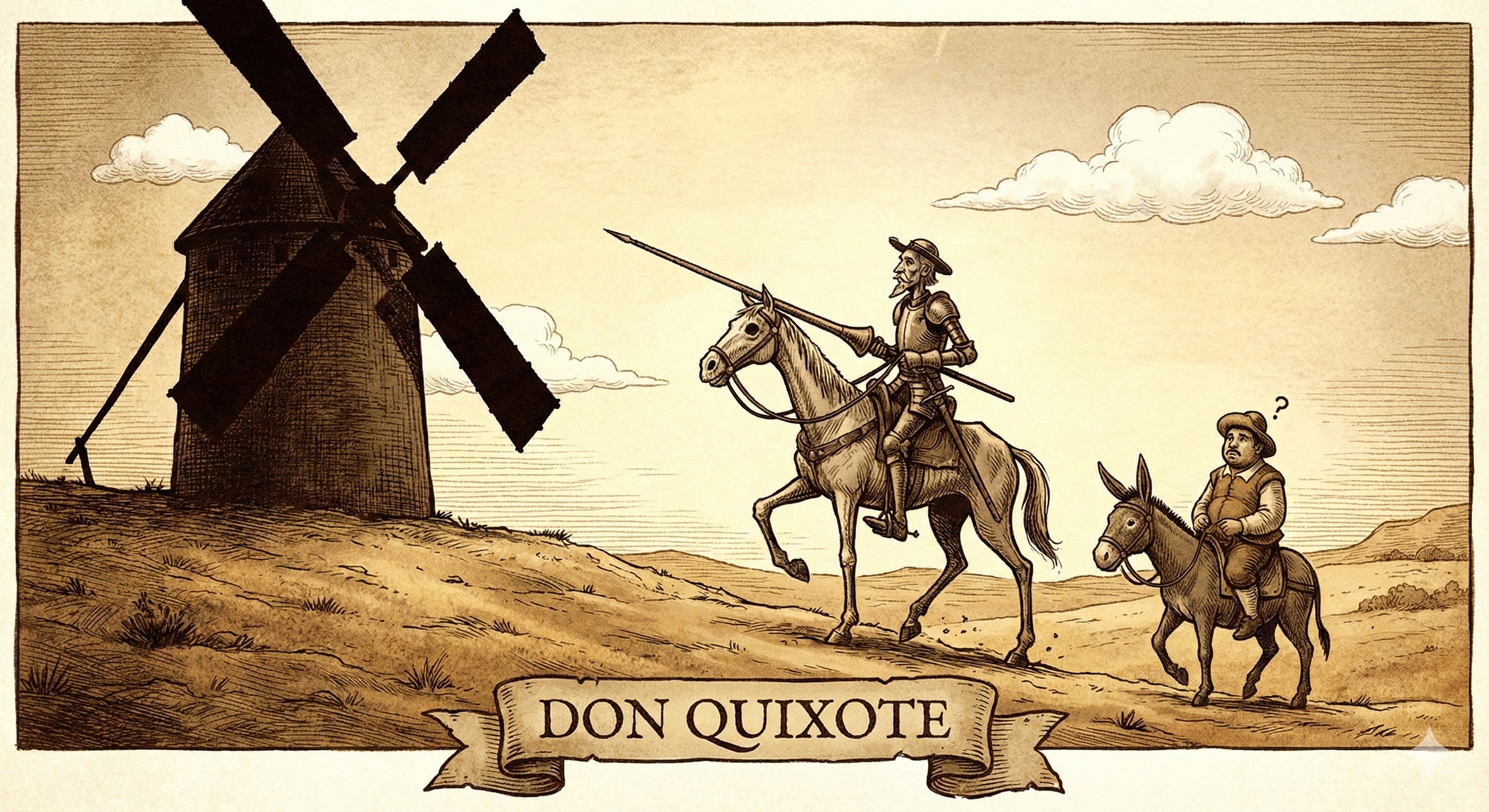
The story begins in La Mancha, Spain, with a middle-aged nobleman named Alonso Quixano. Alonso reads so many books about knights, damsels, and dragons that he literally loses his mind. He decides to become a knight-errant to revive chivalry and serve his nation. He renames himself Don Quixote de la Mancha, puts on a rusty suit of armor, and recruits a simple farmer named Sancho Panza to be his squire, promising him the governorship of an island as a reward.
Tilting at Windmills
The duo sets off on a series of misadventures. Because Quixote sees the world through the lens of his books, he hallucinates constantly. He attacks windmills thinking they are giants (the novel's most famous scene), mistakes a run-down inn for a castle, and perceives a flock of sheep as an opposing army. While Quixote operates on high-minded ideals, Sancho operates on his belly, constantly asking when they will eat. This dynamic creates the original "buddy comedy."
The Meta-Twist (Part Two)
Ten years after the first book was published, Cervantes released Part Two. In a stroke of genius, the characters in the book are now aware of the first book’s publication. People they meet recognize them as "that crazy knight and his squire." A Duke and Duchess invite them to their estate, not to honor them, but to play elaborate, cruel pranks on them for entertainment. This section explores the cruelty of "sane" people compared to the nobility of the "mad" knight.
The Return of Sanity
Eventually, a neighbor from his village disguises himself as the "Knight of the White Moon," challenges Quixote to combat, and defeats him. The condition of defeat is that Quixote must return home and give up knighthood for a year. Brokenhearted, Quixote returns to his village. He falls ill, regains his sanity, renounces his knightly persona, and dies as Alonso Quixano—leaving Sancho and the reader weeping for the loss of the beautiful dream.
4. Key Takeaways
-
Idealism vs. Realism: The central tension of the book asks whether it is better to accept the world as it is (Sancho) or to fight for the world as it should be (Quixote), even if it makes you look foolish.
-
The Power of Perspective: Cervantes shows us that reality is subjective. To Quixote, a barber’s basin is the "Helmet of Mambrino." The book challenges us to question our own perceptions of value and truth.
-
True Nobility: While Quixote is delusional, he is also brave, generous, and strictly moral. The "sane" characters who mock him are often cruel and cynical, forcing the reader to ask who the real hero is.
-
The First "Bromance": The evolution of the relationship between Quixote and Sancho is the heart of the book. They start as master and servant but end as deeply devoted friends who learn from one another’s worldview.
5. Why This Book Is a Must Read
Don Quixote is the grandfather of the novel. Writers from Dostoevsky to Steinbeck have cited it as a primary influence. But beyond its historical resume, it is a must-read because it is a "book for all seasons." When you are young, it is a comedy about a crazy old man. When you are older, it becomes a tragedy about the death of dreams and the harshness of reality.
It teaches us that there is dignity in failure, provided you fail while attempting something great. Reading Don Quixote is a rite of passage that reminds us that sometimes, a little bit of madness is necessary to endure the world.


