
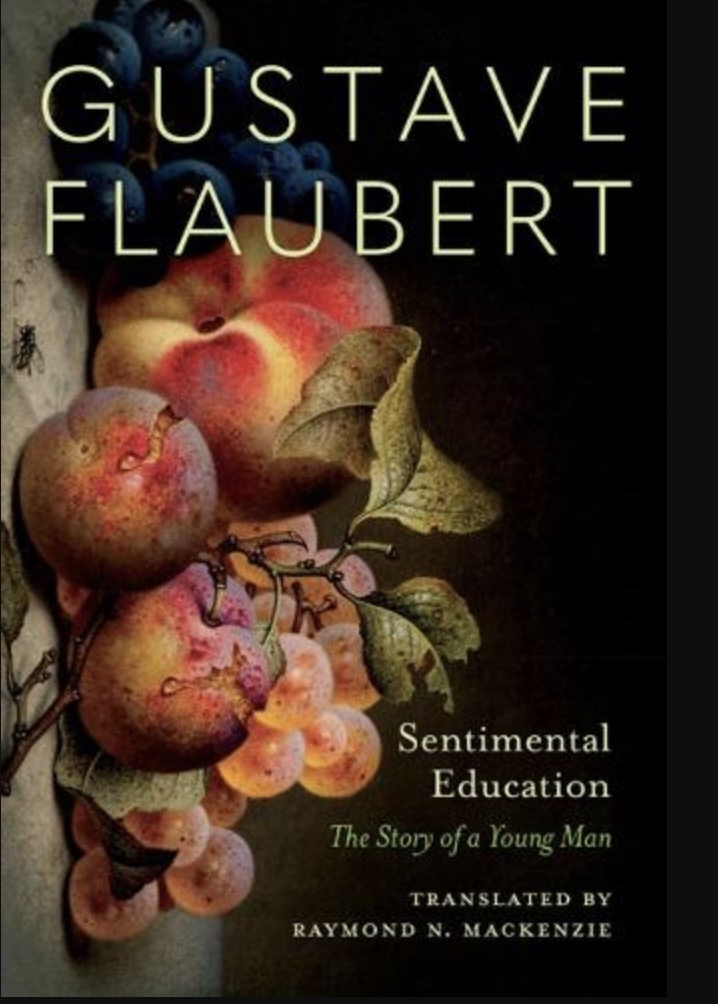
Sentimental Education by Gustave Flaubert
Theodoros Kafantaris
Published on December 27, 2025
1. Introduction
If Madame Bovary is a tragedy about the fatal collision of dreams and reality, Sentimental Education is a slow-burn study of how dreams just sort of... fade away. Published in 1869, this is Gustave Flaubert's most ambitious work, often cited by critics as one of the greatest novels ever written, even if it initially baffled readers.
It is a "coming-of-age" story where the hero never really grows up. It is a romance where the lovers hardly touch. It is a historical epic where the main character sleeps through the history. It is significant because it perfectly captures the feeling of modern drift—the paralysis of having too many choices and not enough conviction. It is the definitive portrait of a generation that promised everything and delivered nothing.
2. About the Author
Gustave Flaubert (1821–1880) By the time he wrote Sentimental Education, Flaubert was already a literary titan, but he was also deeply cynical about human nature. He intended this book to be the "moral history of the men of my generation."
Flaubert witnessed the turmoil of the French Revolution of 1848 and the subsequent rise of Napoleon III, an era marked by wild idealism followed by crushing authoritarianism. He channeled this historical disappointment into his writing. His style here is even more controlled and ironic than in Bovary, using dry wit to mock the mediocrity of his characters while simultaneously painting a breathtakingly beautiful picture of Paris.
3. Story Overview
The story begins in 1840 on a riverboat. Frédéric Moreau, a young man of eighteen filled with vague artistic and romantic ambitions, spots an older woman, Marie Arnoux. She is the wife of Jacques Arnoux, a flashy and somewhat shady art dealer. For Frédéric, it is love at first sight. But this isn't a Romeo and Juliet passion; it is a passive, worshipful obsession. She becomes his idol, the lens through which he views his entire future. He moves to Paris to study law, but mostly he moves to be near her.
Frédéric enters Paris society with high hopes, but he lacks the discipline to succeed. He dabbles in art, then gives up. He tries writing, then stops. He studies law, but gets bored. Instead of building a life, he spends his years hovering around the Arnoux family. He befriends the husband (despite hating him) just to be close to the wife. He drifts between different social circles—the revolutionaries who want to overthrow the government and the aristocrats who want to keep it. He is a chameleon, changing his opinions to suit whoever he is trying to impress at dinner.
As the 1848 Revolution erupts and the monarchy falls, the streets of Paris are filled with barricades and gunfire. However, Frédéric is largely indifferent to history; he is too busy juggling his complicated love life. While pining for the virtuous Madame Arnoux, he falls into a relationship with Rosanette, a fun-loving courtesan who represents earthy pleasure, and briefly courts Madame Dambreuse, a wealthy socialite who represents power. Yet, he is satisfied with none of them. He constantly sabotages his real relationships for the fantasy of Madame Arnoux, a woman he never truly pursues.
The novel doesn't end with a bang, but with a sigh. Years pass. The political fervor dies down. Frédéric's friends sell out their ideals. In the penultimate scene, a now-aged Madame Arnoux visits Frédéric. They share a tender, nostalgic moment, acknowledging their love, but realize it is too late. She leaves, and the "great romance" remains unconsummated. The book ends with Frédéric and his childhood friend, Deslauriers, reminiscing about their past. They conclude that the best memory of their lives was a time in their youth when they visited a brothel, got scared, and ran away before doing anything—a perfect metaphor for a life spent hesitating at the threshold of experience.
4. Key Takeaways
- The Paralysis of Indecision: Frédéric has talent and money, but he achieves nothing because he cannot commit to a single path. Insight: Infinite possibility can be a trap; refusing to choose is ultimately a choice to do nothing.
- Idealization vs. Reality: Frédéric prefers the idea of Madame Arnoux to the reality of any actual woman. Insight: Worshipping a fantasy protects you from the messiness of real intimacy, but it leaves you lonely.
- The Failure of a Generation: Flaubert critiques the "Men of 1848" who talked loudly about revolution and liberty but lacked the substance to govern. Insight: Political and social ideals are useless without the character and discipline to uphold them.
- The Subjectivity of Memory: The characters constantly rewrite their own pasts to make themselves feel better. Insight: We often look back on our youth with rose-tinted glasses to avoid facing the mediocrity of our present.
5. Why This Book Is a Must Read
Sentimental Education is a must-read because it is arguably the first "modern" novel. It doesn't have a traditional plot arc where the hero defeats the villain and gets the girl. Instead, it mirrors the messy, unsatisfying rhythm of real life.
It is a brilliant antidote to the "hustle culture" narrative. It shows us exactly what happens when you let life just happen to you. It is a challenging, sometimes frustrating read, but it is deeply rewarding for its psychological honesty. It forces you to ask: Am I driving my life, or am I just a passenger like Frédéric?


