
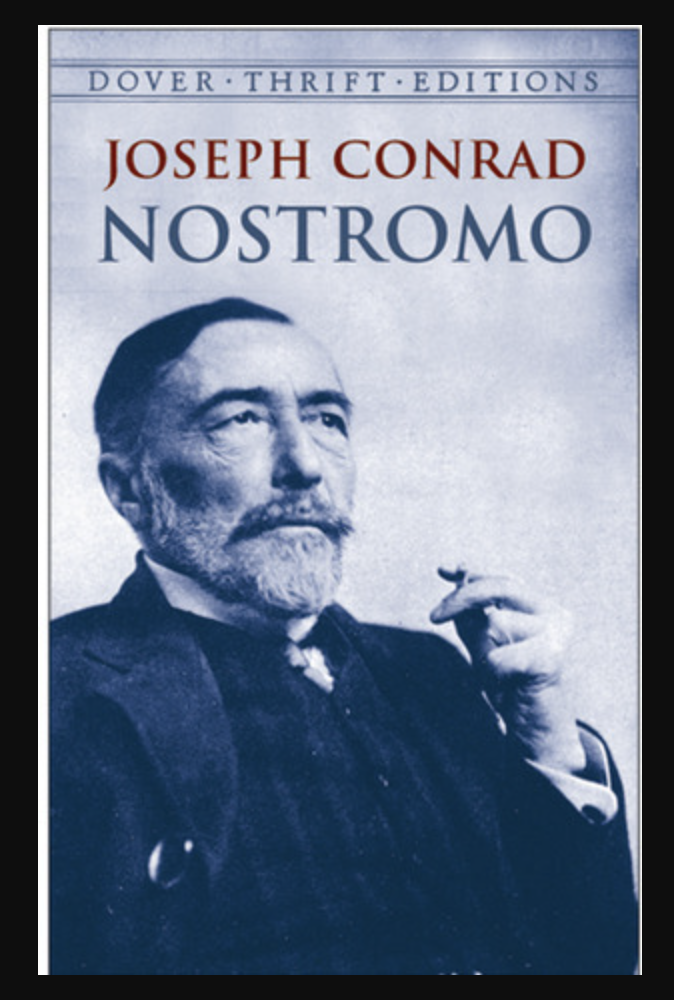
Nostromo by Joseph Conrad
Theodoros Kafantaris
Published on December 12, 2025
1. Introduction
In the vast landscape of classic literature, Joseph Conrad's Nostromo: A Tale of the Seaboard (1904) stands as a towering, complex, and profound achievement. This novel is not a light adventure tale, but a dense, meticulously constructed examination of politics, capitalism, and corruption set in the fictional South American republic of Costaguana, specifically the Occidental Province of Sulaco.
Nostromo is significant because it marks a major turn in the history of the novel—it’s often considered Conrad’s modernist masterpiece and his first great political novel. It delves into the dark heart of material interests and their power to corrupt not just nations, but individual souls. The central metaphor is the San Tomé Silver Mine, which brings immense wealth to Sulaco but ultimately triggers a revolution, fracturing the country and destroying the moral integrity of nearly everyone involved.
2. About the Author
Joseph Conrad (born Józef Teodor Konrad Korzeniowski, 1857–1924) was a Polish novelist who wrote exclusively in English, his third language. Born in a part of Poland then under Russian rule, he went to sea as a young man, eventually becoming a naturalized British subject and a master mariner in the British Merchant Navy. This life at sea and his travels in Africa and Asia provided the rich, often exotic, and morally fraught settings for his greatest works.
Conrad’s style is known for its impressionism, complex chronology, and narrative ambiguity. He frequently employed a narrator (like Marlow in Heart of Darkness and Lord Jim) or multiple, shifting points of view to highlight the subjective nature of truth and history. Nostromo, in particular, uses a complicated timeline that flashes forward and backward to convey the chaos and fate inherent in historical events. An interesting fact is that Conrad wrote Nostromo shortly after the secession of Panama from Colombia (1903), a historical event driven by U.S. and European capitalist interests, which directly informed the novel’s themes of foreign intervention and political instability.
3. Story Overview
The novel opens in media res, giving the fictional Costaguana a detailed, almost mythical history of tyranny and revolution, establishing a background of perpetual instability. The story proper focuses on the events surrounding the rise and fall of the liberal Ribierist government and the ensuing Monterist revolution, all driven by the seemingly benign yet powerfully corrupting influence of the San Tomé Silver Mine.
The central figure is Charles Gould, an English-descended Costaguanero who inherits the derelict San Tomé mine. Determined to bring "order, security, and good faith" to the troubled republic, he believes that the massive wealth generated by the mine—the "material interests"—will stabilize the country. He reopens the mine with American and European capital, turning Sulaco into a wealthy province. However, his obsession with the mine estranges him from his idealistic wife, Emilia Gould, and his single-minded dedication to profit blinds him to the human cost of his “progress.”
When a brutal revolution led by General Montero sweeps across Costaguana, the fate of the mine and Sulaco hangs in the balance. To prevent the massive haul of newly mined silver from falling into rebel hands, Charles Gould orders his men to smuggle it out via the sea. He entrusts this desperate mission to Nostromo (Giovanni Battista Fidanza), the revered Italian Capataz de Cargadores ("boss of the dockers"). Nostromo, whose nickname ironically means "our man," is a figure known for his incredible daring and apparent incorruptibility, a man who lives entirely for his public reputation.
During the chaotic sea voyage, the silver barge is hit by a revolutionary gunboat. Accompanied by the cynical journalist Martin Decoud, Nostromo manages to beach the silver on the desolate Great Isabel island. Decoud, overcome by isolation, eventually commits suicide. Nostromo, after performing a heroic overland ride to save the loyalist cause, keeps the fate of the silver a secret, allowing everyone to believe it was lost at sea. This secret, the hidden treasure, becomes his new and terrible master. He risks his life for an ideal, but the lack of public recognition for his private sacrifice poisons his soul. He begins secretly retrieving the silver ingots, one by one, sacrificing his public reputation for a private, corrupting wealth.
The revolution ends with Sulaco successfully seceding from Costaguana, becoming the prosperous, independent state of the Occidental Republic, founded on the very wealth of the silver mine. Charles Gould’s material interests have, ironically, created the desired stability, but at the cost of his soul and marriage. Nostromo, who now has wealth but no public glory, falls in love with Linda Viola, the daughter of an Italian innkeeper. His secret life leads to a tragic end when he is mistakenly shot and killed by Linda’s father while attempting to retrieve more silver, a slave to the very treasure he risked his life to save.
4. Key Takeaways
- The Corrupting Nature of Materialism: The novel powerfully argues that economic interests (the silver) are the true, amoral engine of history and are fundamentally corrupting to all—the idealist, the patriot, and the hero.
- The Illusion of Idealism: Charles Gould’s attempts to bring order through wealth fail, demonstrating that idealism without ethical roots and human compassion is simply another form of self-serving obsession.
- The Weight of Reputation: Nostromo's tragic downfall illustrates that a life lived solely for public recognition is hollow, and the absence of glory can be as destructive as greed.
- History is Subjective and Chaotic: The novel’s fragmented, non-linear structure reinforces Conrad’s theme that history is not a clear, orderly progression, but a jumble of subjective narratives and accidental events.
- The Bystander’s Burden: The character of Emilia Gould serves as the moral center, the only one who truly witnesses and understands the moral destruction wrought by the silver and the revolution, embodying the despair of the compassionate observer.
5. Why This Book Is a Must Read
Nostromo is not an easy read, but it is an essential one. It is a monumental work of literary genius that anticipated the political and economic realities of the 20th century, exploring the dark side of capitalism and imperialism with chilling accuracy. It belongs on the "100 Books You Must Read" list because of its innovative narrative technique, its massive scope, and its profound, unsparing critique of human nature under the pressure of power, wealth, and ego. It is a tragic epic that asks whether any human endeavor, no matter how noble in intent, can escape the corrosive power of material interests.


