
Mahabharata by Vyasa
Theodoros Kafantaris
Published on July 08, 2026
1. Introduction
At approximately 100,000 verses—roughly seven times the length of the Iliad and Odyssey combined—the Mahabharata is the longest epic poem in world literature. Attributed to the sage Vyasa, it tells of the great war between two branches of a royal family: the Pandavas and the Kauravas. But the war occupies only a portion of the epic. Wrapped around it are myths, philosophical discourses, and the Bhagavad Gita—Krishna's counsel to the warrior Arjuna on the eve of battle.
2. About the Author
The Mahabharata is traditionally attributed to the sage Vyasa, who is also a character within the epic. Vyasa is considered the compiler of the Vedas and the author of many Puranas. However, the epic was likely composed over centuries by multiple authors, with Vyasa serving as a symbolic figure. The text's historical development spans from roughly 400 BCE to 400 CE, reflecting layers of cultural and philosophical evolution in ancient India.
3. Story Overview
The Mahabharata centers on the rivalry between two sets of cousins: the five Pandava brothers (Yudhishthira, Bhima, Arjuna, Nakula, and Sahadeva) and the hundred Kaurava brothers, led by the eldest, Duryodhana. The conflict arises over the throne of Hastinapura. The Pandavas, sons of King Pandu, are rightful heirs, but the blind king Dhritarashtra (father of the Kauravas) favors his own sons. After a series of intrigues, the Pandavas are exiled for thirteen years. Upon their return, Duryodhana refuses to restore their kingdom, leading to the great war at Kurukshetra.
The epic's narrative structure is complex, employing a frame story: the bard Ugrasravas recites the epic to an assembly of sages, who in turn listen to the sage Vaishampayana recounting it. Within this, numerous sub-stories—such as the tale of Nala and Damayanti, the story of Savitri, and the legend of the churning of the ocean—are embedded, enriching the main plot with moral and philosophical lessons. Key characters include Lord Krishna, who serves as Arjuna's charioteer and divine guide; Bhishma, the granduncle bound by a vow of celibacy and loyalty; and Draupadi, the Pandavas' wife whose humiliation sparks the conflict.
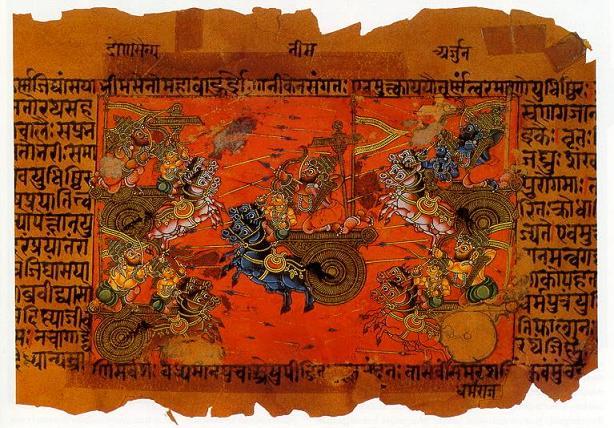
Major themes include dharma (righteous duty), the nature of justice, the inevitability of fate, and the complexities of human relationships. Notable scenes include the dice game where Yudhishthira loses everything, including Draupadi, leading to her attempted disrobing—a pivotal moment that sets the stage for war. The Bhagavad Gita, a philosophical dialogue between Krishna and Arjuna on the battlefield, addresses Arjuna's moral dilemma about fighting his kin. The war itself is described in vivid detail, with heroic deaths and divine interventions. Ultimately, the Pandavas win, but the victory is pyrrhic: almost all warriors perish, and the survivors are haunted by grief. The epic concludes with the Pandavas' final journey to heaven, where they face tests of their virtue. The Mahabharata's literary significance lies in its encyclopedic scope, blending history, mythology, philosophy, and law into a cohesive narrative that has shaped Indian culture for millennia.
4. Key Takeaways
- No one is entirely righteous in war: The epic shows that even the virtuous Pandavas resort to deception and violence, highlighting the moral ambiguities of conflict.
- The Gita teaches action without attachment: Krishna's counsel to Arjuna emphasizes performing one's duty without attachment to outcomes, a key tenet of Hindu philosophy.
- An epic can contain a universe: The Mahabharata is not just a story but a compendium of myths, ethics, and spiritual teachings, reflecting the vastness of human experience.
5. Why This Book Is a Must Read
The Mahabharata is essential for anyone interested in world literature, philosophy, or Indian culture. Its exploration of dharma in the face of impossible choices resonates across time and cultures. The Bhagavad Gita alone has inspired leaders from Mahatma Gandhi to modern thinkers. Reading the epic offers profound insights into human nature, the costs of ambition, and the search for meaning in a chaotic world.


