
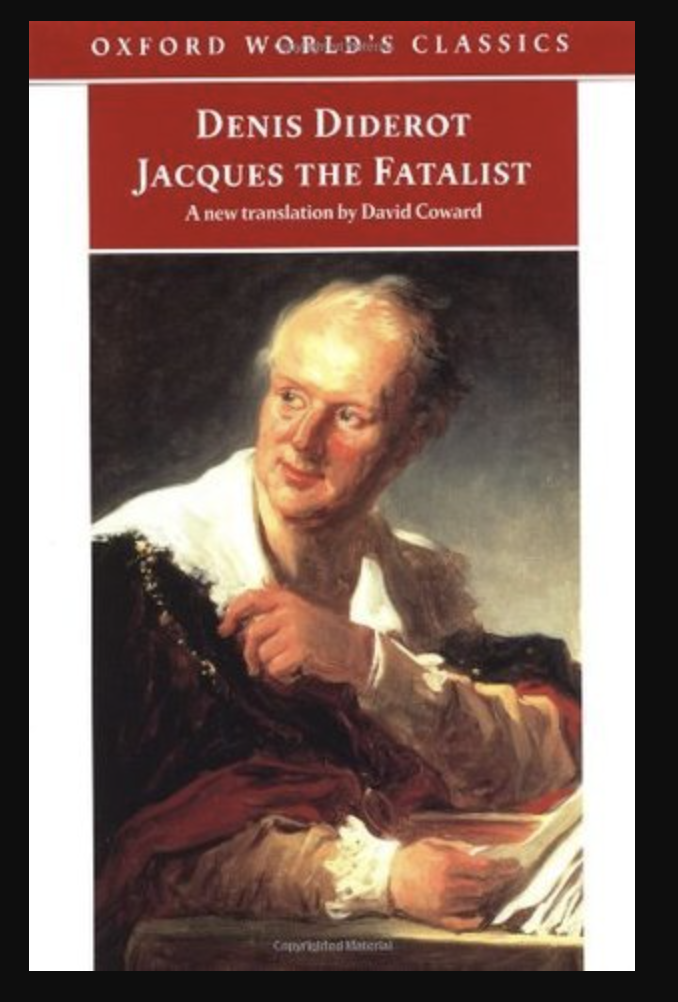
Jacques the Fatalist by Denis Diderot
Theodoros Kafantaris
Published on December 14, 2025
1. Introduction
We continue our literary expedition with one of the most intellectually playful and formally challenging books ever written: Jacques the Fatalist and His Master (written c. 1773, published 1796) by Denis Diderot. This book is not a straightforward novel; it is a dizzying, hilarious, and philosophical conversation that constantly breaks the fourth wall, interrupting its own narrative to question the very nature of storytelling and destiny.
Diderot's significance lies in his role as a leading light of the French Enlightenment and as the chief editor of the monumental Encyclopédie. Jacques the Fatalist is his literary response to the prevailing rationalism of his age. It is noteworthy for being a precursor to modernist and postmodernist fiction, constantly drawing attention to its artificiality. Its impact is immense; it forces the reader to confront profound questions about free will, determinism, and the artifice of fiction while following a plot that gleefully embraces chaos.
2. About the Author
Denis Diderot (1713–1784) was a French philosopher, art critic, and writer who was a key figure of the Enlightenment. His life was dedicated to the pursuit and dissemination of knowledge, most famously through his tireless work on the Encyclopédie, a massive compilation of all human knowledge that challenged the authority of both the Church and the Monarchy. This commitment led to years of persecution, censorship, and even imprisonment.
Diderot's style is characterized by his dialogic approach, his deep skepticism, and his relentless intellectual curiosity. He explored complex ideas through conversation and satire rather than dogma. Jacques the Fatalist is a direct reflection of his philosophical stance, particularly his materialism and determinism. He believed that all human actions, thoughts, and emotions are merely the result of a chain of physical causes, or "the great scroll" of necessity. The book is, in part, a philosophical dialogue disguised as a picaresque novel, inspired by Laurence Sterne's equally unconventional Tristram Shandy.
3. Story Overview
The novel is a journey—both physical and literary—chronicling the travels of Jacques, a valet, and his Master, who never receives a name. The frame narrative is simple: they are traveling to an unknown destination, and the Master continually asks Jacques to tell the story of his loves. The plot, however, is anything but simple, frequently derailing into tangents, philosophical debates, and stories told by other characters. The central philosophical premise driving the plot (or lack thereof) is fatalism. Jacques believes that everything that happens—good or bad—is "written up above" on a Great Scroll and is therefore predetermined. His Master, meanwhile, is hopelessly inept and relies entirely on Jacques for guidance. Their constant dialogue is the novel's true subject, as they test the limits of fatalism against their own actions, often resulting in comical contradictions. For instance, when Jacques is robbed, he accepts it as written, yet he is prepared to fight the robbers if he gets the chance!
The narrative is structured as a series of embedded tales and lengthy digressions. Whenever Jacques begins the story of his loves, the Master interrupts, or they meet a new character (such as the Host or the Marquis des Arcis) who then takes over the narrative with their own long, involved story. These stories—about love, vengeance, military life, and philosophical despair—often echo or contradict the themes of Jacques's own life. Diderot, as the omniscient and intrusive narrator, frequently steps in to address the reader directly, mocking literary conventions and justifying his narrative chaos. The true conflict is not between Jacques and the Master, but between Diderot and the traditional 18th-century novel. By constantly commenting on his failure to stick to a plot (e.g., "The reader must be getting very impatient with me..."), Diderot highlights the artificiality of fiction. He shows that every literary choice—what to include, what to omit, where to interrupt—is an arbitrary decision made by the author. This self-awareness makes the novel a brilliant piece of metafiction, anticipating literary experiments centuries later.
Key characters include Jacques, the fatalistic yet resourceful valet; his nameless Master, who is both dependent and domineering; and a host of secondary characters like the Hostess, who tells a complex tale of love and revenge, and the Marquis des Arcis, whose story intertwines with Jacques's own past. Notable scenes include the repeated interruptions of Jacques's love story, the philosophical debates during their travels, and the final revelation of Jacques's past, which is left tantalizingly incomplete. The novel's literary significance lies in its radical deconstruction of narrative form, making it a cornerstone of postmodern literature long before the term existed.
4. Key Takeaways
- The Illusion of Free Will: Diderot challenges the notion of free will by placing all actions under the banner of determinism. While we feel free, our choices are simply the inevitable result of prior physical causes.
- The Power of Dialogue: The novel demonstrates how complex philosophical and ethical ideas are best explored through lively, spontaneous conversation rather than dry treatise.
- Storytelling as Life: Diderot argues that life is essentially a collection of random, interconnected stories, and the only real order comes from the person telling them (or the reader putting them together).
- The Author's Arbitrary Power: By breaking the fourth wall, Diderot reminds readers that the author is a dictator who controls every single aspect of the created world, highlighting the artificial nature of literary realism.
- A Lesson in Literary Form: The book teaches that a great work of fiction does not need to follow strict rules; it can be a fragmented, unconventional, and anarchic experience that still manages to illuminate human truths.
5. Why This Book Is a Must Read
Jacques the Fatalist is a must-read because it is a philosophical riot—a book that laughs at the conventions it simultaneously uses. It is a founding text of modern self-aware fiction, a bridge between Enlightenment philosophy and postmodern literary theory. Diderot manages to weave deep intellectual debates about fate and morality into a hilarious, rambling road trip. It earns its place as a classic for its audacity, its intellect, and its enduring relevance as a masterpiece of metafiction that asks readers to look beyond the story and consider the very act of reading itself.


