
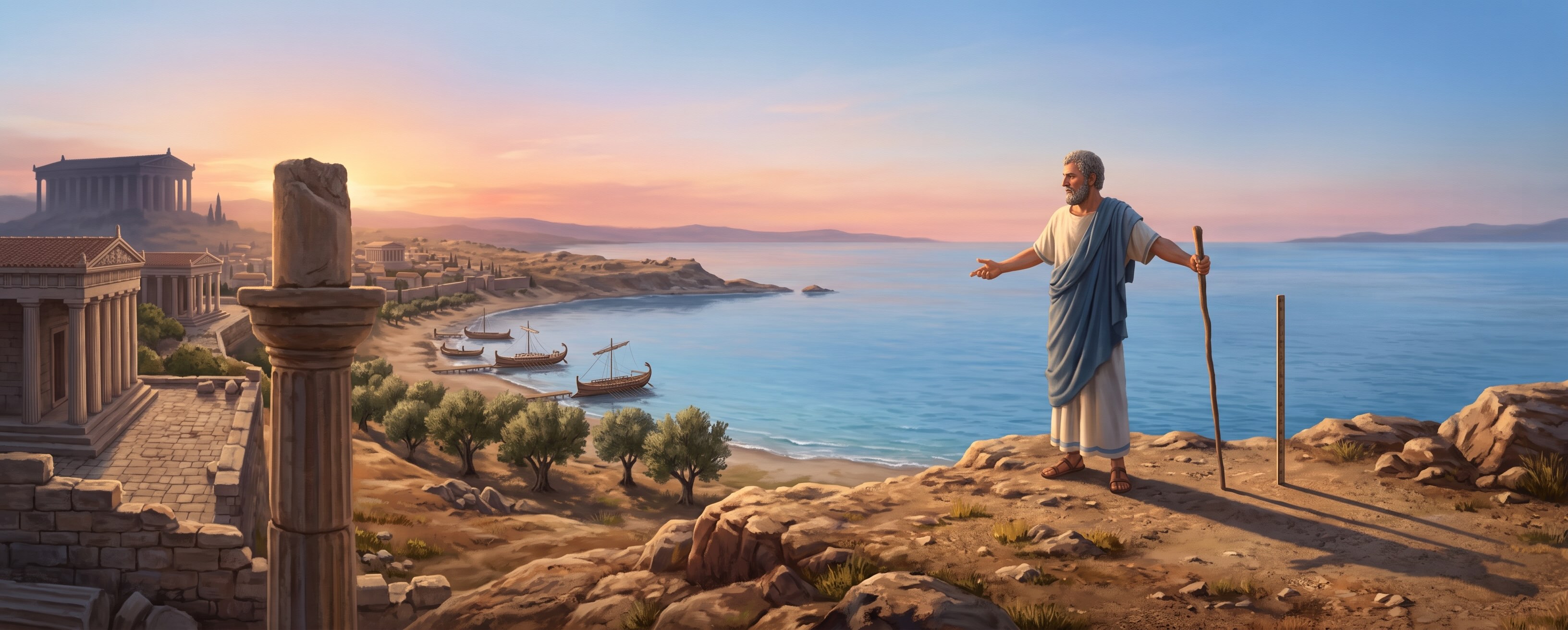
Thales of Miletus: The Father of Western Philosophy
Theodoros Kafantaris
Published on September 21, 2026
Mythology ended the day this man looked at a shadow.
Before Thales of Miletus (~624 – ~546 BCE), if the ground shook, Poseidon was angry. If lightning struck, Zeus was throwing a fit.
Human fate was entirely passive—dependent on divine mood swings, sacrifices, and luck.
Thales changed humanity forever by introducing a radical concept: Physical Causality.
Here is the story of the father of Western philosophy—and how to apply his core frameworks today.
Who Was Thales of Miletus?
Aristotle named Thales the very first philosopher in the Western tradition.
He marked the historical transition from Mythos (storytelling) to Logos (rational analysis).
He wasn't an abstract theorist trapped in an ivory tower. He was a practical polymath, engineer, and strategist:
-
The Pyramid Breakthrough: He measured the exact height of the Great Pyramids without climbing them. He simply waited for the time of day when his own shadow matched his height, knowing the pyramid's shadow would match its height at that exact second.
-
The Eclipse Prediction: He accurately predicted the solar eclipse of May 28, 585 BCE—stopping an active war between the Lydians and Medes in its tracks out of sheer awe.
-
The Army Engineer: He rerouted the River Halys so King Croesus's army could cross without spending months building bridges.
The 3 Mental Models of Thales
1. The Search for the First Principle (Archê)
Thales asked a question no human had ever formulated before: "What is the fundamental material substance behind all complex reality?"
His answer was Water.
While his conclusion was primitive, his hypothesis changed human civilization: Complex, chaotic systems can be reduced to a single, unified physical law.
2. Naturalism Over Narrative
When earthquakes struck, Thales argued the Earth floated on an ocean and was rocked by subterranean waves.
By replacing divine temper tantrums with mechanical causes, he established the foundation of modern scientific inquiry: Cause and Effect.
3. Strategic Foresight & Asymmetry
People mocked Thales for being poor, claiming philosophy was useless.
To prove a point, he used his astronomical observations in winter to predict an unprecedented olive harvest the following season.
While it was still cold, he paid small deposits to lease every olive press in Miletus at bottom-dollar rates.
When the massive harvest arrived, every farmer needed a press at the exact same time. Thales rented them back on his own terms, generating a fortune overnight.
His message was clear: Philosophers can easily be rich—their ambition is simply focused on bigger things.
How to Apply Thales Today
1. Strip Away the Noise to Find the "Water"
When solving complex problems in business, engineering, or life, don't get distracted by surface symptoms. Ask: What is the core variable driving this entire system?
2. Replace Narrative Coping with Diagnostic Causality
When a project fails, drop emotional narratives like "I was unlucky" or "the algorithm hated me." Look at the mechanics. Find the structural failure point.
3. Position Yourself Before the Season Shifts
Thales didn't work harder during the harvest; he secured asymmetric leverage when everyone else was dormant. Look for undervalued options long before market demand spikes.
Summary
-
First Principle: Reduce complex chaos to its core driver.
-
Naturalism: Focus on structural mechanics, not luck or emotion.
-
Strategy: Secure leverage while the crowd is looking elsewhere.
Episode 1 of The Compass of Philosophers series.
If you found this valuable:
-
Bookmark this post to revisit these frameworks later.
-
Follow for Episode 2: Anaximander & The Boundless Infinite.
What's the "water" (the single most critical variable) in your current project right now?


