
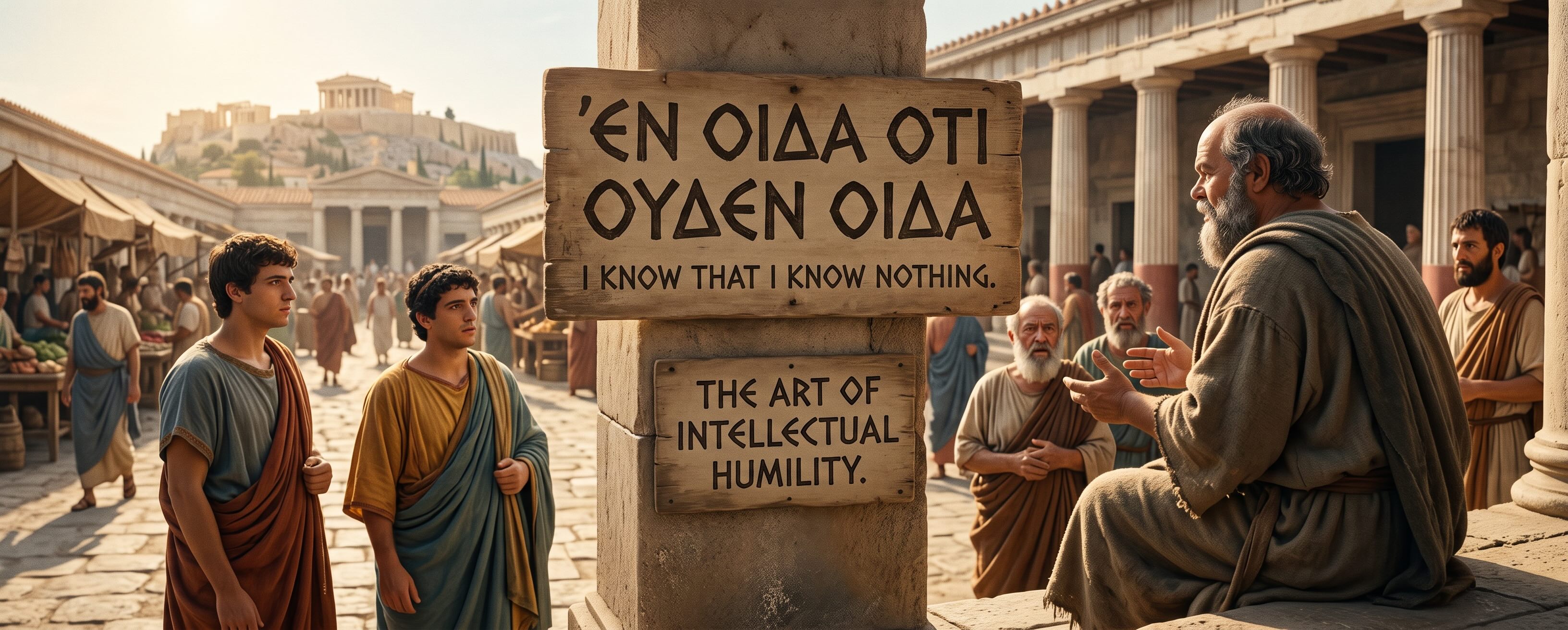
Socrates: The Wisdom of Knowing Nothing
Theodoros Kafantaris
Published on September 23, 2026
The Oracle of Delphi declared him the wisest man in Greece.
His response was to spend the rest of his life proving that he knew nothing at all.
In Episodes 1–4, we followed the ambitious Presocratics: Thales searching for water, Anaximander for the Boundless, Heraclitus for flux, Parmenides for Being. All of them looked outward, hunting for a first principle in the cosmos.
Socrates (~470 – 399 BCE) changed the question. He turned the same ruthless inquiry inward, onto the human soul.
Here is the story of the philosopher who made "I don't know" the beginning of all wisdom—and how to use his method today.
Who Was Socrates?
Socrates was an Athenian citizen, the son of a stonemason, a veteran of the Peloponnesian War, and the most irritating man in Athens. He wrote nothing. He held no office. He charged no fee.
What he did was walk into the Agora and ask questions—of politicians, poets, generals, and craftsmen—until their confident opinions collapsed under their own contradictions.
He is credited with:
-
Turning Philosophy from the Cosmos to Conscience: The Presocratics asked what the world is made of. Socrates asked how a person should live. Ethics, not physics, became the centre of Western thought.
-
The Socratic Method (Elenchus): A discipline of relentless, structured questioning, designed to expose false certainty and push the mind toward real definitions instead of comfortable opinions.
-
The Examined Life: His central claim—that the unexamined life is not worth living—was not a metaphor. He chose death rather than abandon the practice of inquiry.
The 3 Mental Models of Socrates
1. Intellectual Humility (The Wisdom of Knowing Nothing)
When the Oracle at Delphi said that no one was wiser than Socrates, he was baffled. So he began testing the claim, questioning the men reputed to be wise. He found that they knew nothing of the most important things, yet believed they knew everything.
His conclusion: he was wiser only in one narrow respect—he did not think he knew what he did not know.
The breakthrough: Your certainty, not your ignorance, is the real obstacle to learning. Expert blindness is dangerous precisely because it feels like competence.
2. The Dialectic (Truth Through Friction)
Socrates never lectured. He asked one question, then followed it with another built on the answer, and another—until the definitions broke, and a clearer one could emerge.
He played the ignorant student on purpose, forcing the other person to do the real work of thinking.
His insight: Knowledge is not transferred, it is extracted—and contradiction is the tool that extracts it.
3. The Examined Life (The Audit of the Self)
Socrates treated his own life as a hypothesis that needed daily testing: are my desires, beliefs, and actions consistent with how a human being should live?
The inner voice he described never told him what to do—only what not to do. A warning system for the soul.
His breakthrough: Unexamined assumptions are the most expensive things you own.
How to Apply Socrates Today
1. Run a Zero-Based Knowledge Audit
Before a critical decision, write down what you believe you know and mark each item as verified, assumed, or inherited. Treat the assumed and inherited entries as unknown until you test them. Most strategic errors are inherited certainties that were never checked.
2. Manage by Asking, Not Telling
When a team member brings you a problem, resist the answer. Ask what they have already tried, how they would know if they were wrong, and what would have to be true for the opposite to be correct. You will lose a little speed once and gain a thinker permanently.
3. Hold a Weekly Ethical Audit
Once a week, turn the Socratic question on your own week: Did my actions match my stated values? Where did I defend a position out of ego rather than evidence? Which belief did I keep only because it was convenient? Ten minutes of honest contradiction prevents months of drift.
Summary
-
Intellectual Humility: Knowing what you do not know is the beginning of wisdom.
-
The Dialectic: Questioning beats telling; truth emerges from tested contradiction.
-
The Examined Life: A life without self-audit runs on inherited assumptions.
Episode 5 of The Compass of Philosophers series.
If you found this valuable:
-
Bookmark this post to revisit these frameworks later.
-
Follow for Episode 6: Plato and the World of Ideal Forms.
Which belief are you defending out of habit rather than evidence?


