
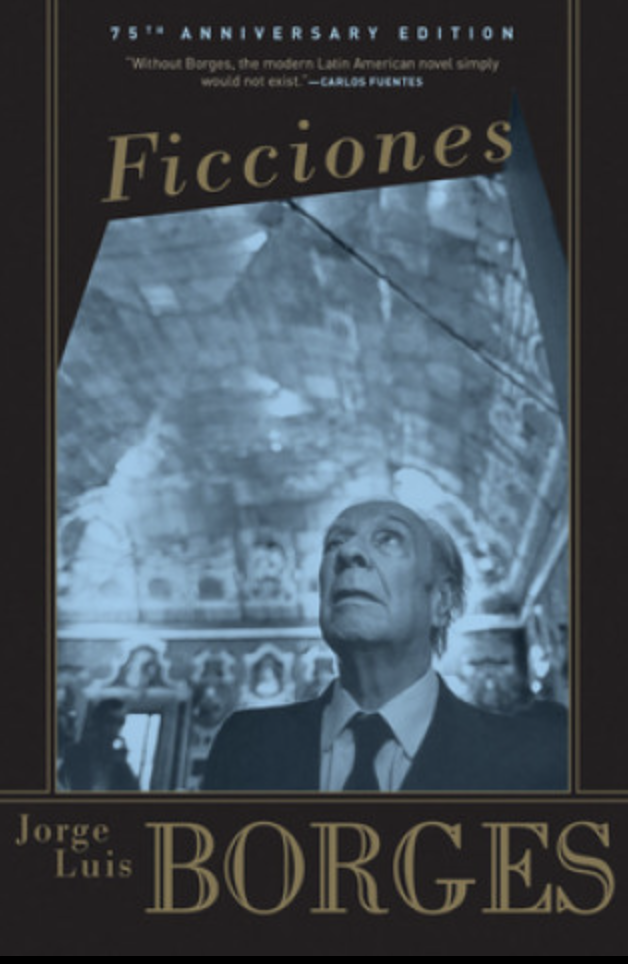
Ficciones by Jorge Luis Borges
Theodoros Kafantaris
Published on December 03, 2025
1. Introduction
If books are doors, Ficciones is a hallway of doors inside of doors—some leading to libraries, some to dreams, and at least one that may be an infinite labyrinth pretending to be a story. First published as two collections in the 1940s and later gathered into one iconic volume, Ficciones stands as one of the most influential works of modern literature. It shaped the development of magical realism, metafiction, and literary philosophy, leaving fingerprints on authors from Umberto Eco to Italo Calvino.
Why is it noteworthy? Because Borges manages to do more in 10 pages than some authors do in 500—question reality, challenge time, redesign storytelling itself, and still make you grin with a sly joke hidden in a footnote.
2. About the Author
Jorge Luis Borges (1899–1986) is the Argentine writer responsible for redefining what fiction could be. Known for his short stories, essays, and poems, he often blended philosophy, mythology, metaphysics, and detective tropes into compact literary puzzles.
Borges was nearly blind for much of his adult life, a fact that adds emotional and symbolic depth to his obsession with infinite libraries, cyclical time, and recursive worlds. Among his major works are The Aleph, Labyrinths, and The Book of Imaginary Beings.
A fun Borges fact: he once described himself as “not very political,” which is a polite way of saying he managed to annoy both the left and right in Argentina at different times. Although never truly controversial in a scandalous sense, his views and literary elitism occasionally landed him in cultural debates. But what truly endures is his dazzling intellect and unmatched imagination.
3. Story Overview
Ficciones is not a single narrative but a collection of intellectually playful, deeply philosophical stories. The volume is divided into two parts: The Garden of Forking Paths (1941) and Artifices (1944). Each story is a compact universe, often blending genres such as detective fiction, fantasy, and philosophical essay. Below are four of its most iconic stories, which together illustrate Borges's central preoccupations: the nature of time, the infinite, memory, and the power of fiction.
I. The Garden of Forking Paths combines espionage, metafiction, and a philosophical riddle. The protagonist, a Chinese spy in WWI, discovers that a missing labyrinth is not a physical structure but a novel that imagines every possible outcome of every moment. The central theme is that time branches endlessly, and every decision creates a new universe. Think of it as quantum physics meets political thriller meets ancient Chinese metaphysics. The story's structure mirrors its theme: it is a detective story that leads to a philosophical revelation, and its narrative branches in the reader's mind.
II. The Library of Babel presents a universe composed of an infinite library containing every possible book—every variation, every typo, every truth, every nonsense. The narrator describes the librarians' futile search for meaning in this chaos. This story explores the crushing vastness of knowledge, the search for truth, and the absurdity of trying to make sense of the infinite. If Google Search were a physical place, this would be it (but with even more disappointment and wandering). Borges's description of the library's hexagonal rooms and the librarians' despair is a powerful allegory for the human condition.
III. Tlön, Uqbar, Orbis Tertius is one of Borges's most famous works. It begins with a conversation about the nonexistent country of Uqbar, which leads to the discovery of an encyclopedia entry describing a fictional world called Tlön. Slowly, artifacts from Tlön begin appearing in the real world, and fiction begins overwriting reality. The story is both a satire of academic scholarship and a prophetic warning about how ideas shape reality—sometimes dangerously. It raises questions about idealism, perception, and the power of collective belief.
IV. Funes the Memorious introduces a young man who, after an accident, can remember every detail of everything he experiences. What seems like a superpower quickly becomes a burden—he cannot generalize, cannot dream, cannot forget. It is a meditation on memory, identity, and how forgetting is often essential to being human. Borges uses Funes to explore the limits of human cognition and the role of abstraction in thought.
Together, these stories showcase Borges's mastery of the short form and his ability to weave complex philosophical ideas into engaging narratives. His use of footnotes, false references, and layered narratives creates a sense of depth and playfulness that rewards rereading. Ficciones is a cornerstone of postmodern literature and continues to inspire writers and thinkers worldwide.
4. Key Takeaways
- Reality is more fragile than we think. Borges shows how language, memory, and perspective shape what we call “truth.”
- Knowledge can enlighten—or overwhelm. The search for meaning can be heroic, but also exhausting in a world that contains infinite information.
- Stories are living things. Fiction doesn’t just reflect the world—it influences it, reshapes it, and sometimes surpasses it.
- Limitations can spark creativity. Borges’s short form, written partly due to blindness, proves that constraints can lead to brilliant innovation.
- The universe is vast, but humor helps. Despite the heavy themes, Borges often winks at the reader. Complexity doesn’t have to be grim.
5. Why This Book Is a Must Read
Ficciones is a cornerstone of modern literature because it dares to question the foundations of reality, storytelling, and human understanding—all within short, elegant narratives that blend philosophy with imagination. It remains astonishingly contemporary, influencing everything from science fiction to postmodernism to internet culture. No “100 Books You Must Read” list is complete without this masterpiece because it isn’t just a book—it’s an intellectual adventure that transforms the way you think about books, knowledge, and the act of reading itself.


