
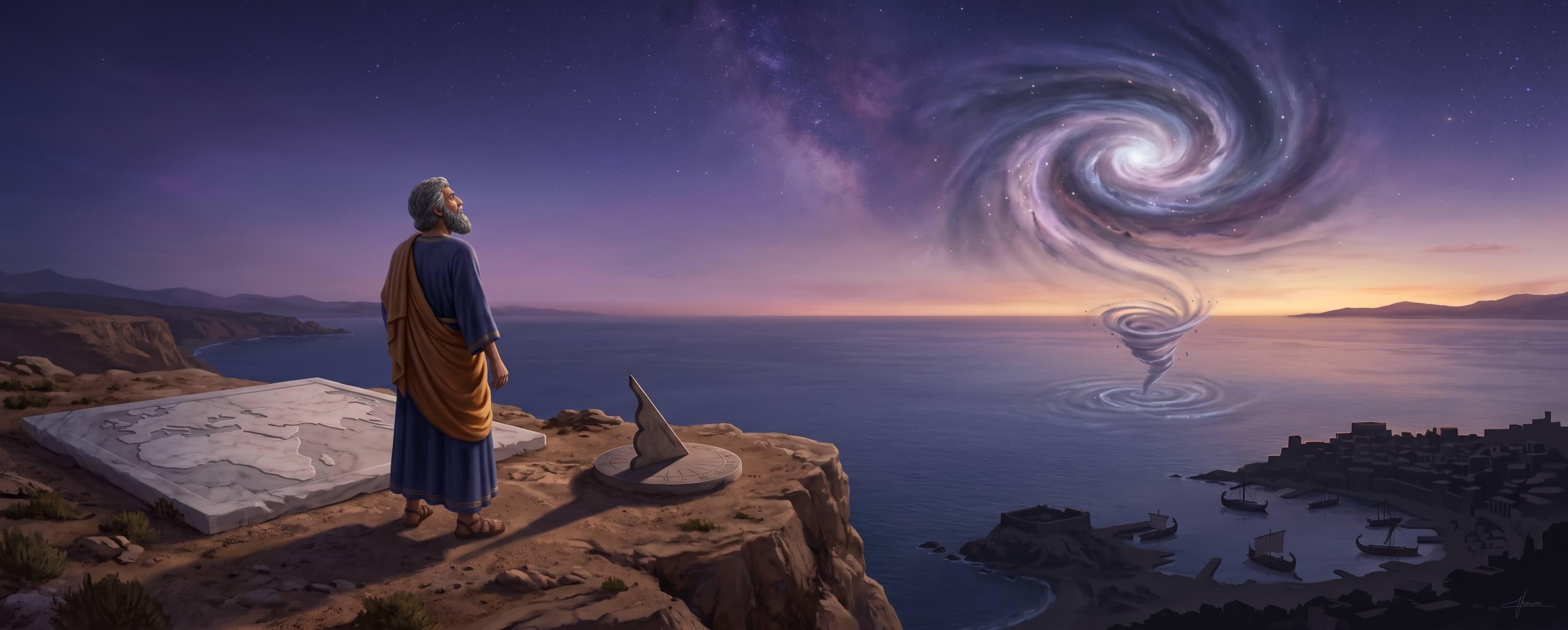
Anaximander: The Boundless Infinite
Theodoros Kafantaris
Published on September 22, 2026
If everything comes from Water, where did Water come from?
In Episode 1, we met Thales, who defined the primary substance as a physical element. But his greatest student, Anaximander (~610 – ~546 BCE), saw a major flaw in this logic.
Anaximander realized that if any one element (like water) were infinite, it would have long ago conquered and eliminated its opposites (like fire).
To solve this, he needed something that was none of the elements, yet gave rise to all of them.
He defined the Archê not as matter, but as a conceptual infinite origin: The Apeiron.
Here is the story of the philosopher who conceived the first theory of the cosmos—and how to apply his frameworks today.
Who Was Anaximander?
Anaximander was a younger contemporary and student of Thales in Miletus. He is considered the very first scientist to rely entirely on mechanical, testable hypotheses for reality.
While Thales was a polymath observer, Anaximander was an architect of grand, abstract systems. He is credited with:
-
The First Map of the World: He created the first known attempt to visualize the entire inhabited Earth from above, treating the world as a measurable system.
-
The Introduction of the Gnomon: He brought the vertical sundial indicator from Babylon, using it not just to track time, but to determine seasons, solstices, and the geometry of the planetary positions.
-
The First Theory of Evolution: He noted that human infants are uniquely helpless and would not survive on their own. Therefore, humans must have descended from a species capable of rapid independence. He hypothesized that all animals ultimately derived from simpler life forms generated from the primal moisture of the early Earth—descending from fish-like creatures.
The 3 Mental Models of Anaximander
1. The Power of The Boundless (Apeiron)
Anaximander defined his origin principle, the Apeiron, as that which is "boundless," "undefined," and "infinite."
This is the ultimate progenitor. It has no physical properties—it is not water, not air, not fire. It is a limitless, swirling reservoir.
From this infinite chaos, pairs of opposites are "separated out" (hot/cold, wet/dry) to create the physical cosmos we perceive.
The breakthrough: The root cause of a system cannot possess the physical constraints of the system's outputs.
2. Justice Through Universal Balance
For Anaximander, the cosmos is a battlefield where opposites constantly struggle for dominance.
If 'Hot' dominates during summer, it commits "injustice" against the 'Cold.' Nature maintains balance by forcing the 'Hot' to decay in winter, making reparations.
Aristotle preserved this rare quote, arguably the first sentence of Western Philosophy: "They give justice and reparation to one another for their injustice according to the assessment of Time."
His insight: Every stable system operates on homeostatic checks and balances, requiring decay to create renewal.
3. Free-Floating Structural Integrity
While Thales thought the Earth floated on water, Anaximander made a revolutionary leap.
He proposed the Earth was a cylinder, floating in nothing but perfect balance.
Why does it not fall? Because it is positioned exactly at the mathematical center of the infinite Apeiron. It is equidistant from everything; therefore, it has no motive to fall in any single direction.
His breakthrough: Symmetry, equilibrium, and mathematical balance can create structural stability, even without physical support.
How to Apply Anaximander Today
1. Design from the "Boundless" Phase
When launching a new concept, strategy, or creative work, resist the urge to immediately define its specific, measurable "elemental" properties (features, budget, schedule). Start in the Apeiron (the Boundless/Undefined): What infinite reservoir of potential or deep human need are you tapping into before you constrain it?
2. Audit Your Homeostatic Systems
In business or personal discipline, if you over-index on a single "element" (such as rapid growth), you commit injustice against the rest of the system (like stability or operational resilience). Time always demands balance. Create forced periodic decay to allow your constraints to renew themselves.
3. Use Equilibrium as Leverage
When designing architectures, organizations, or processes, seek structural integrity through mathematical balance and neutrality rather than brute force physical props. Stability is often created by removing external dependencies.
Summary
-
The Boundless (Apeiron): The ultimate origin is infinite and undefined.
-
Cosmic Justice: System stability requires balance and decay through Time.
-
Equilibrium: Mathematical balance creates structural integrity.
Episode 2 of The Compass of Philosophers series.
If you found this valuable:
-
Bookmark this post to revisit these frameworks later.
-
Follow for Episode 3: Heraclitus and the Fire of Flux.
Are you designing your current projects from a defined feature set, or from the boundless conceptual origin?


