
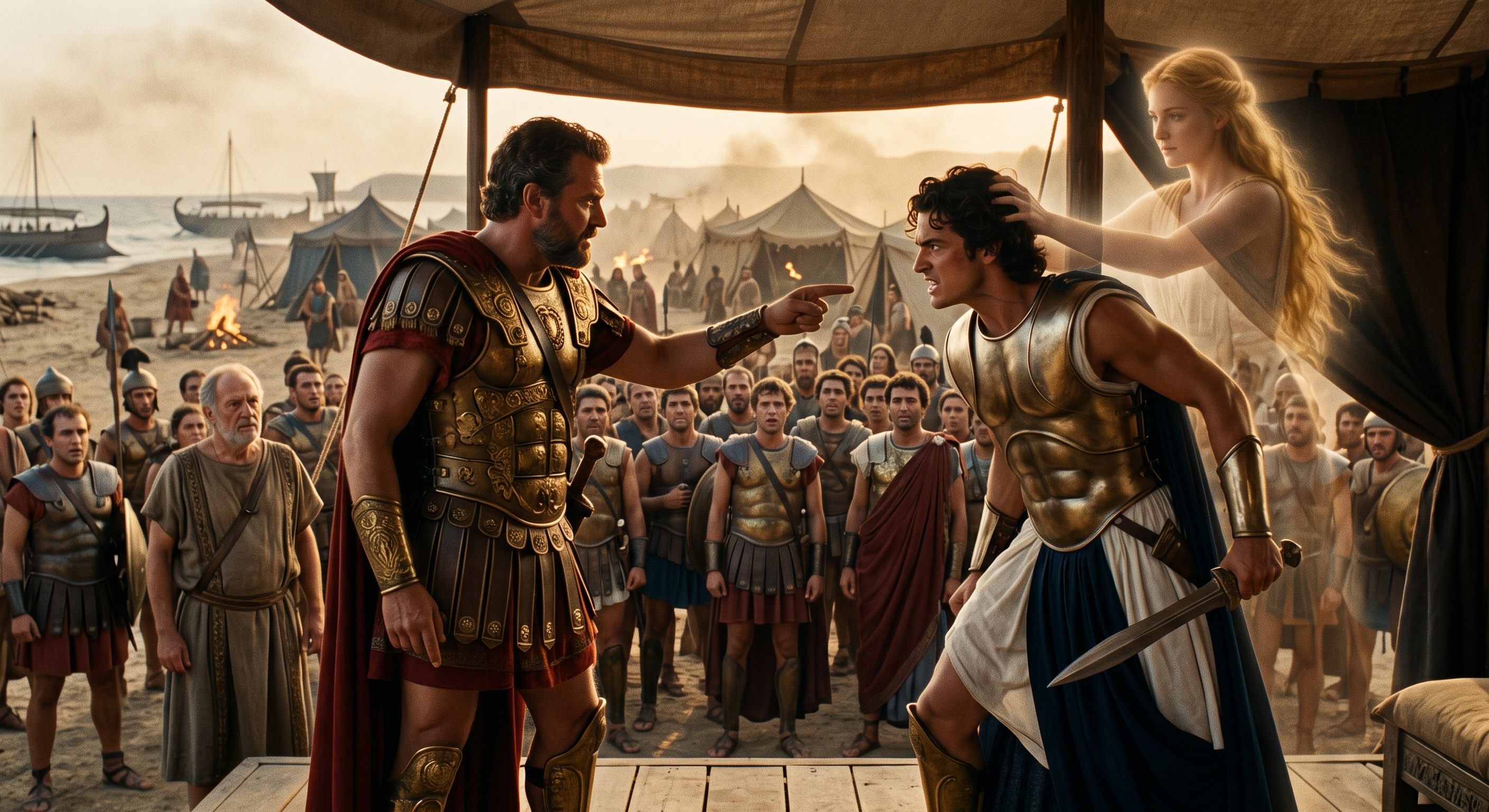
The Quarrel Over Briseis
Theodoros Kafantaris
Published on September 28, 2026
The Scene
The Iliad doesn't open with a battle. It opens with a plague and an argument — and the argument is more revealing than the plague.
A priest named Chryses comes to the Greek camp begging for his daughter back. Agamemnon, the commander of the whole army, is holding her as a war prize. He refuses, insults the priest, and sends him away. The priest prays to Apollo, and Apollo answers by raining arrows of plague on the Greek camp for nine straight days.
Eventually the army forces Agamemnon to give the girl back — the camp is dying, there's no way around it. But Agamemnon, publicly humiliated by having to back down, announces he'll take a replacement prize from someone else in the army. He chooses Briseis — the woman awarded to Achilles, the army's best fighter.
Achilles is enraged — not really about Briseis. He says so himself.
What he can't stand is being shown, in front of the entire army, that his status can be overruled by rank whenever Agamemnon feels threatened.
He comes within a breath of killing Agamemnon on the spot. Athena physically grabs him by the hair to stop him. Instead, Achilles does something almost stranger than violence: he withdraws. He stops fighting. He lets his own side start losing the war, on purpose, until they're forced to recognize what he's worth.
The Mechanism
Homer is careful to make sure we don't mistake this for a fight over a woman-as-property, distasteful as that framing is to modern ears. He has Achilles say outright that he doesn't even particularly want her — plenty of other war prizes exist. What he can't tolerate is the public downgrade. Agamemnon didn't quietly reallocate resources; he did it in front of witnesses, specifically to remind Achilles who outranks whom.
The fight was never about the object. It was about rank being reasserted through humiliation — in public, where it would be seen. And once that happens, the actual issue becomes almost irrelevant: the only thing left to resolve is the humiliation itself, which no material settlement can undo.
This is also why negotiation fails so completely here. Nestor, the camp's elder statesman, tries to talk both men down with perfectly reasonable arguments. It doesn't work, because reasonable arguments address the surface conflict, not the status wound. You cannot logic someone out of a grievance that was never really about logic.
The Mirror
You've seen this fight. It rarely involves armies.
-
The coworker who explodes over a meeting invite they weren't cc'd on — not because the meeting mattered, but because everyone saw them left out.
-
The sibling dispute over a piece of furniture worth forty dollars that somehow becomes the fight that ends a relationship for a decade — because what's actually being fought over is who their parents loved best.
-
The executive who kills a project not because it's bad, but because it was greenlit without asking him first.
-
The online pile-on that starts over one sentence and becomes a referendum on someone's entire character — because the sentence was never the point; being seen to win the exchange was.
And Achilles' response — refusing to fight, letting the whole operation suffer until his value is acknowledged — is, uncomfortably, the oldest recorded version of a modern move: withholding your labor as leverage. Quiet quitting with better PR. He's not lazy and he's not done caring; he's making an entire army feel his absence so they understand what his presence was worth. It works, eventually, at enormous cost — to him and to everyone around him.
Three thousand years later, we still haven't figured out how to have the status argument honestly. We dress it up as a fight about the org chart, the inheritance, the credit line, the cc list — anything but the actual sentence:
You made me feel small in front of people whose opinion I care about.
Homer just wrote it down without the euphemism.
Read the series: Next: The Wrath Economy → · All 10 posts
Post 1 of 10 in Homer Iliad


