
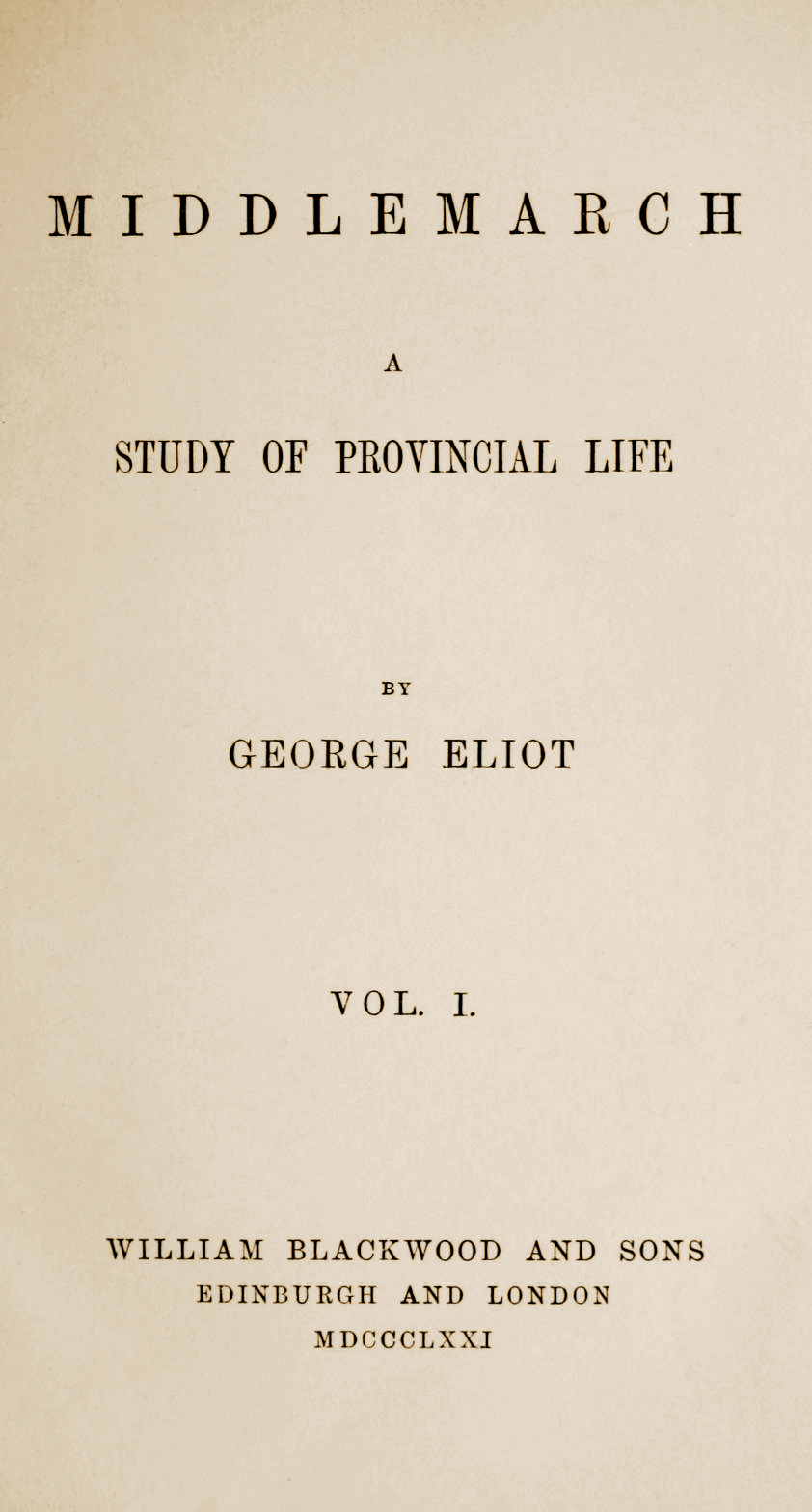
Middlemarch by George Eliot
Theodoros Kafantaris
Published on July 07, 2026
1. Introduction: The Greatest English Novel
Virginia Woolf called it "one of the few English novels written for grown-up people." George Eliot's Middlemarch: A Study of Provincial Life (1871-72) is that rare thing: a novel of ideas that never forgets to be a novel of heart. Set in a fictional Midlands town during the Reform Act years, it follows multiple interweaving plots centered on characters whose dreams and limitations collide with reality.
2. The Central Characters
Dorothea Brooke
At the heart of the novel is Dorothea, a young woman of fierce religious intensity trapped in a society that offers no outlet for her intelligence. She dreams of grand projects and being a helpmate to a great man. Her tragedy lies in mistaking the desiccated scholar Edward Casaubon for a modern Pascal, entering a disastrous marriage where her luminous intelligence slowly dims in the shadow of his mediocrity.
Tertius Lydgate
If Dorothea represents idealism of the spirit, Lydgate represents idealism of science. A young doctor with revolutionary ideas about medicine, he arrives in Middlemarch determined to reform healthcare. Instead, his marriage to the beautiful but shallow Rosamond Vincy becomes a slow erosion of his ambitions. His gradual compromise reads like an autopsy of a soul.
Fred Vincy and Mary Garth
The third major plot follows Fred, a charming but feckless young man, and Mary, the plain-spoken, morally grounded woman he loves. Unlike the novel's other couples, they earn happiness through genuine growth. Their story provides the novel's most hopeful note: that people can change for the better.
3. Major Themes
The Limits of Idealism
Every major character begins with grand aspirations; every one discovers reality scales those aspirations down. Eliot does not mock their dreams—she mourns them. The famous final paragraph captures this: "The growing good of the world is partly dependent on unhistoric acts; and that things are not so ill with you and me as they might have been, is half owing to the number who lived faithfully a hidden life, and rest in unvisited tombs."
Marriage as Crucible
Middlemarch is one of literature's most penetrating examinations of marriage—not as romantic fulfillment but as a crucible that reveals character. Each marriage illuminates a different aspect of this most intimate of human bonds.
Provincial Life as Universal Mirror
By focusing on a single town, Eliot achieves something remarkable: a universe in miniature. The petty politics, the gossip, the social dynamics—all reflect the larger forces reshaping 19th-century England.
4. Why Middlemarch Matters Today
Published over 150 years ago, Middlemarch remains astonishingly relevant. Its questions are our questions: How do we balance ambition with reality? What makes a marriage work? Can idealism survive contact with the world? Eliot's psychological penetration—showing us the gap between public faces and private selves—feels almost modernist in its sophistication.
5. Key Takeaways
- Idealism without pragmatism leads to suffering: Dorothea and Lydgate both learn this the hard way.
- Marriage reveals character, it does not create it: Who you are before determines what your marriage becomes.
- Small lives can have large meaning: Heroism is not reserved for the famous or powerful.
- Compassion is the highest wisdom: Eliot judges none of her characters completely; she understands them all.


