
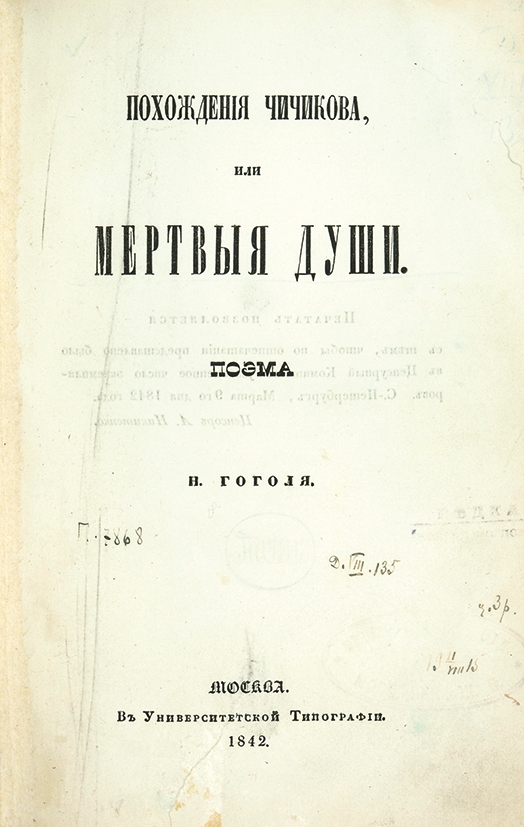
Dead Souls by Nikolai Gogol
Theodoros Kafantaris
Published on July 07, 2026
1. Introduction
Nikolai Gogol's Dead Souls (1842) begins with one of literature's strangest premises: a charming but mysterious traveler, Pavel Ivanovich Chichikov, arrives in a provincial Russian town and begins buying 'dead souls'—deceased serfs whose names still appear on official census lists. Why? Because in Tsarist Russia, landowners were taxed on their serfs until the next census. By purchasing these legally 'alive' but actually dead serfs, Chichikov plans to mortgage them as collateral for a fortune. This satirical masterpiece is often considered the first great Russian novel, blending absurdist comedy with a scathing critique of social corruption.
2. About the Author
Nikolai Gogol (1809–1852) was a Ukrainian-born Russian writer whose works laid the foundation for 19th-century Russian realism. Known for his unique blend of the grotesque, the fantastical, and the satirical, Gogol influenced generations of writers, including Dostoevsky and Kafka. His other major works include the short story collection Evenings on a Farm Near Dikanka and the play The Government Inspector. Gogol's later years were marked by religious crisis and self-doubt; he burned the manuscript of the second part of Dead Souls shortly before his death.
3. Story Overview
The novel follows Pavel Ivanovich Chichikov, a former civil servant of modest means, as he travels through the Russian countryside with a peculiar scheme. He visits a series of landowners, each embodying a distinct vice, and proposes to buy their dead serfs—those who have died since the last census but are still listed as alive. The landowners, ranging from the sentimental Manilov to the miserly Plyushkin, react with varying degrees of confusion, suspicion, and greed. Chichikov's charm and cunning allow him to secure the deeds, but his activities soon arouse the curiosity of the townspeople, leading to rumors that threaten to expose him.
Gogol uses these encounters to paint a vivid portrait of provincial Russia. Each landowner represents a different facet of moral decay: Manilov's empty sentimentality, Korobochka's petty paranoia, Nozdryov's reckless debauchery, Sobakevich's cynical materialism, and Plyushkin's dehumanizing avarice. The narrative is punctuated by digressions and lyrical passages, most famously the 'Troika' passage at the novel's end, where Chichikov's carriage becomes a symbol of Russia's uncertain destiny.
The novel was conceived as the first part of a three-part epic, modeled on Dante's Divine Comedy, with Chichikov's redemption planned for later volumes. However, Gogol struggled with the sequel, eventually burning the manuscript in a fit of religious despair. What remains is a fragmentary but powerful work that satirizes the emptiness of Russian society while probing the nature of the human soul. The title Dead Souls refers both to the deceased serfs and to the spiritual deadness of the living characters.
4. Key Takeaways
- Greed wears many masks: Each landowner embodies a different form of moral corruption, from sentimentalism to miserliness, showing that greed is not a single vice but a spectrum of human failings.
- Laughter is the sharpest weapon: Gogol exposes social rot through comedy, not preaching. The absurdity of the premise and the grotesque characters make the critique more biting than any moral lecture.
- The unfinished can be perfect: The novel's incomplete state—a fragment of a planned trilogy—adds to its mystique. The lost second part reminds us that sometimes what is absent is more powerful than what is present.
5. Why This Book Is a Must Read
Dead Souls is a cornerstone of Russian literature, offering a unique blend of satire, absurdity, and profound insight. Its influence on later writers—from Dostoevsky to Bulgakov—is immense. The novel's exploration of greed, identity, and the human condition remains relevant today. Gogol's masterful use of language and his ability to create unforgettable characters make this a work of enduring brilliance. Despite its fragmentary nature, Dead Souls is a complete experience: a darkly comic journey into the heart of a nation and the soul of its people.


