
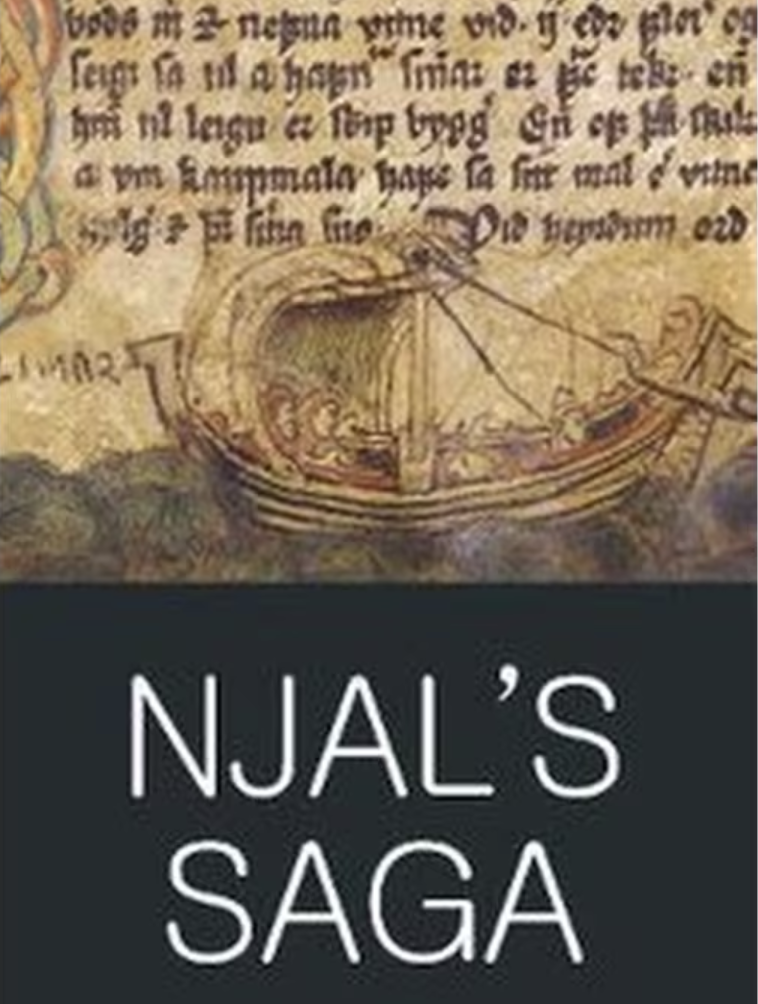
Njál’s Saga
Theodoros Kafantaris
Published on November 28, 2025
Introduction
If you’ve ever wondered what would happen if sharp legal minds, combustible family ties, and extremely dramatic beard-burning collided in medieval Iceland—Njál’s Saga has you covered. Written in the 13th century and set in the Viking Age, this saga stands as one of the most sophisticated and emotionally resonant works of Old Norse literature. It’s not just a tale of feuds and fire; it’s a sweeping narrative that explores honor, loyalty, law, and the stubborn human tendency to escalate conflicts long past the point of reason (a trait that, sadly, remains timeless).
Considered one of the pinnacles of saga literature, Njál’s Saga has shaped how scholars understand medieval Nordic culture, has influenced modern storytelling, and continues to fascinate readers who appreciate layered characters and slow-burning drama—sometimes literally.
About the Author
Author: Unknown (which, admittedly, provides an air of mystery and makes it impossible to tag them on social media)
As with many Icelandic sagas, the authorship remains a scholarly guessing game. Some believe a single, refined storyteller crafted the saga; others argue it evolved through oral tradition before being written down. What we do know:
-
It was composed in 13th-century Iceland, centuries after the events it describes.
-
It belongs to the genre of Íslendingasögur, or "Sagas of Icelanders," known for realistic prose, stoic emotional restraint, and an occasional axe-related misunderstanding.
-
The saga reflects a society transitioning from pagan honor culture to Christian legal order.
-
Its legal detail has fascinated historians—some even call it the world’s first courtroom drama (just with more chainmail).
The anonymity enhances the text’s mythic aura, reminding us that stories sometimes outlast the storytellers.
Story Overview
1. The Meeting of Minds (and Swords)
At the heart of the saga are two central figures: Gunnar, a charismatic warrior, and Njál, a wise, beardless legal genius (yes, his lack of beard is mentioned often enough to count as a character trait). Their friendship anchors the early narrative, as Gunnar’s prowess draws both admiration and envy. Conflicts snowball—because in saga-land, a small insult can blossom into generations of retribution—and despite Njál’s attempts to broker peace, clan politics and wounded pride push events toward violence.
2. Feuds, Flames, and Fate
As tensions intensify, betrayals and retaliations unfold with tragic inevitability. The saga blends stark realism with an awareness of fate, suggesting that once a feud begins, even the wisest cannot stop it. The infamous burning of Njál and his family becomes the emotional and moral center of the tale and one of the most haunting scenes in world literature. It’s a chilling reminder that cycles of revenge consume not only the guilty but also the good.
3. Justice, Law, and an Evolving World
After the devastating burning, the story shifts into the realm of legal settlement and Christian moral reasoning. Trials, compensation negotiations, and moral debates take center stage. The saga reveals a society grappling with the tension between personal vengeance and communal law—an issue humanity is still trying to sort out, preferably without arson.
4. Honor, Conversion, and Closure
In its final chapters, the saga turns toward reconciliation, redemption, and spiritual transformation. Characters embark on pilgrimages, seek forgiveness, and reckon with the weight of their choices. It’s a quieter conclusion, emphasizing the possibility—though not the certainty—of peace. The saga ends not with triumph but reflection, offering a profoundly human resolution.
Key Takeaways
-
Honor can be constructive—or catastrophically explosive. The saga shows how rigid honor codes can both bind a community and set it ablaze.
-
Law is a civilizing force—but only if people choose to follow it. Njál’s legal wisdom highlights the ongoing struggle between justice and emotion.
-
Violence escalates faster than anyone expects. A single slight becomes a generational tragedy, mirroring real social dynamics.
-
Friendship can endure even in a culture built on rivalry. Gunnar and Njál’s bond is surprisingly tender amid all the spear-throwing.
-
Personal growth isn’t just modern self-help fluff. Characters evolve spiritually and morally, suggesting humans have always sought transformation.
Why This Book Is a Must Read
Njál’s Saga earns its place among the “100 Books You Must Read” because it is not only a cornerstone of Nordic literature but also a timeless exploration of human behavior. Its themes—revenge, loyalty, law, social pressure, and the long arc of consequence—feel as relevant today as they were a millennium ago. From a cultural perspective, it offers a window into early Icelandic society, the development of legal systems, and the emotional architecture behind epic storytelling. From a personal growth perspective, it invites readers to reflect on conflict, pride, and the hard work of making peace. Few ancient works feel this alive, this modern, and this profoundly human.

