
The Catalogue of Ships
Theodoros Kafantaris
Published on October 19, 2026
The Scene
Right before the most famous list in ancient literature, the Iliad almost falls apart.
Agamemnon decides to test his army's morale by telling them, falsely, that the war is lost and they should sail home. It's supposed to be reverse psychology — he expects the men to protest. Instead, nine years of exhaustion take over, and the entire army stampedes for the ships in open relief, desperate to escape. It takes Odysseus running through the camp, physically beating stragglers back with a scepter and shaming the ringleaders by name, to stop what is, for a few hundred lines, a genuine mutiny in progress.
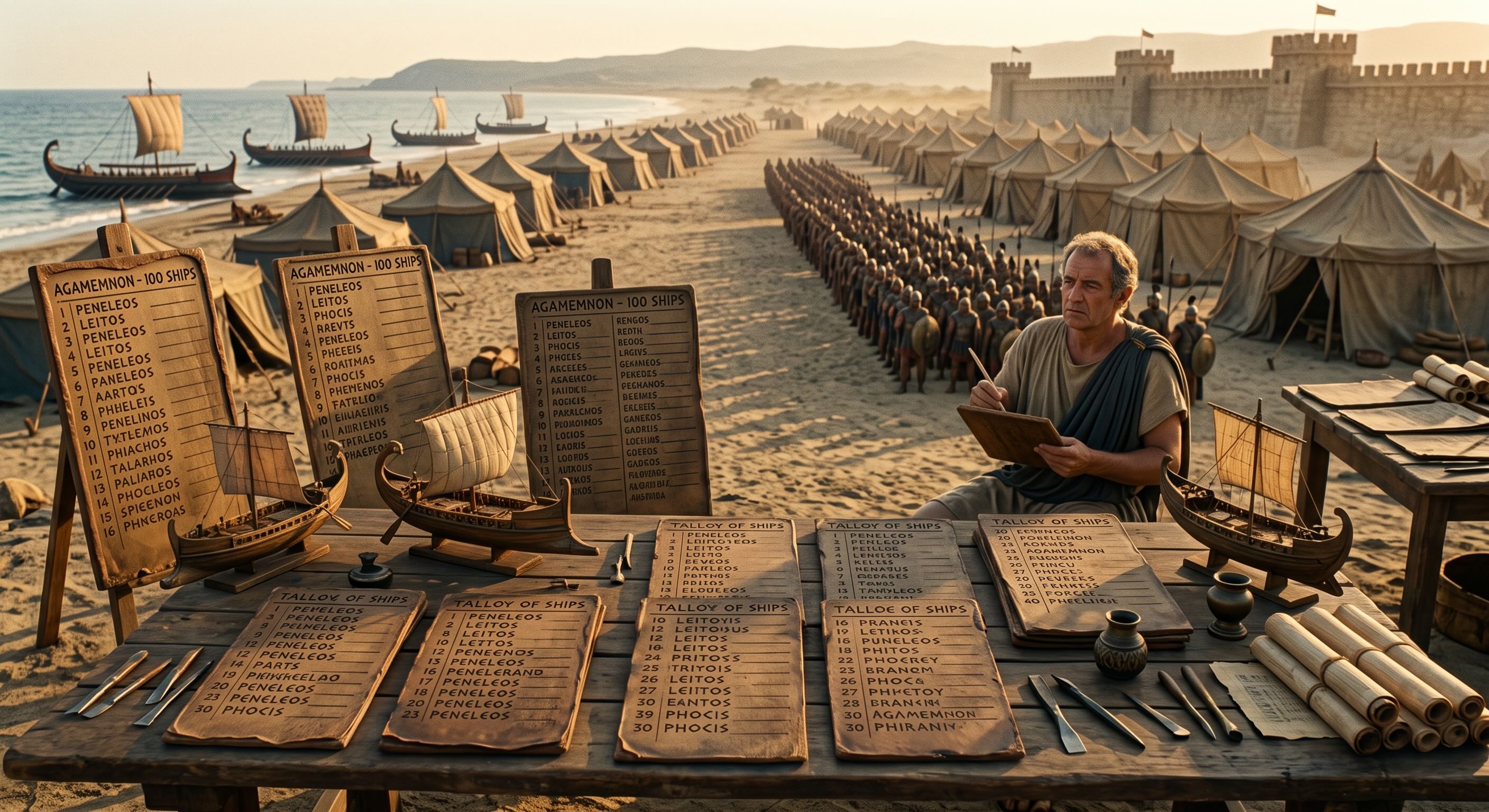
And then, immediately after this near-collapse, Homer does something strange: he stops the story cold and gives us the Catalogue of Ships. Page after page of it. Which city sent how many vessels, under which commander, tracing minor genealogies nobody asked for — the Boeotians with Peneleos and Leitos and fifty ships, the men of Phocis, of Euboea, of a dozen towns most readers have never heard of and will never hear of again. It is, by wide agreement, the part of the Iliad everyone skips. Then a shorter, matching catalogue follows for the Trojan side.
It's easy to read this as Homer padding the poem or showing off his research. But its placement is too exact to be an accident: he puts the least dramatic passage in the entire epic directly on top of the most chaotic one.
The Mechanism
That placement is the point. The mutiny scene proves something uncomfortable: this army is not a unified force bound by shared purpose. It's tired, coerced, one bad rumor away from dissolving. The catalogue is Homer's answer to that fear — not with more inspiring rhetoric, but with an audit. Forty-some contingents, each independently raised, independently shipped, independently commanded, all still present and accounted for. The catalogue isn't there to entertain you. It's there to reassure you that the coalition, whatever its cracks, is real and load-bearing.
It also quietly redefines what power means in this world. Agamemnon commands the expedition not because he's the best fighter — he isn't, and everyone including Agamemnon knows it — but because he brought the most ships: a hundred, more than double anyone else's contribution. Command, in the catalogue's logic, tracks mobilization capacity, not valor. That's a genuinely different currency from the kleos economy running through the rest of the poem, where individual glory is everything. Underneath the duels and speeches, someone still has to know how many spears actually showed up.
This is why the catalogue reads as boring: bureaucracy always does, next to heroism. But it's also why it's structurally necessary. Every fight Achilles wins, every rousing speech Nestor gives, is downstream of the fact that this list exists and holds — that ships were built, oaths were kept, contingents actually sailed. Glory is what gets sung about. Logistics is what makes the glory possible in the first place.
The Mirror
This is the part of every institution that never makes it into the story people tell about it.
Nobody makes a movie about the seating chart, the supply manifest, the troop-contribution table at a NATO summit, or the spreadsheet a campaign manager updates every night listing which field offices are actually staffed and which are just addresses on a website. But those documents are frequently the difference between an alliance that holds and one that evaporates the moment things get hard — the exact thing the Greek army almost did at the ships.
A coalition's real strength was never the speeches its leaders gave; it was whether the numbers in the ledger matched the promises that were made.
You can watch the same pattern after almost any organizational near-mutiny. A company goes through a wave of resignations or a public morale crisis, and what actually stabilizes it — more often than the all-hands pep talk — is leadership publishing the boring stuff:
-
The real headcount.
-
The resourcing plan.
-
Who reports to whom.
-
What's actually being shipped this quarter.
It's not inspiring reading. It's not meant to be. It's meant to do exactly what the catalogue does: prove that the thing you're all supposedly part of is still real, still counted, still there.
And there's a sharper, slightly uncomfortable version of Agamemnon's logic still running today: the person in charge of a war, a merger, a movement is disproportionately likely to be the one who mobilized the most resources, not the one most skilled at the actual work on the ground — the best-funded founder, not the best engineer; the general with the most divisions, not the best tactician.
We tend to notice this and call it unfair, or call it politics. Homer just wrote it down as the plain mechanics of how large efforts actually get organized, three thousand years before anyone needed a word for logistics.
Read the series: ← Previous: The Bargain Sarpedon Makes · Next: Helen on the Wall → · All 10 posts
Post 4 of 10 in Homer Iliad


