
Helen on the Wall
Theodoros Kafantaris
Published on October 26, 2026
The Scene
Right before the fight that's supposed to end the whole war, the Iliad does something almost nobody remembers about it: it stops to let a woman give color commentary.
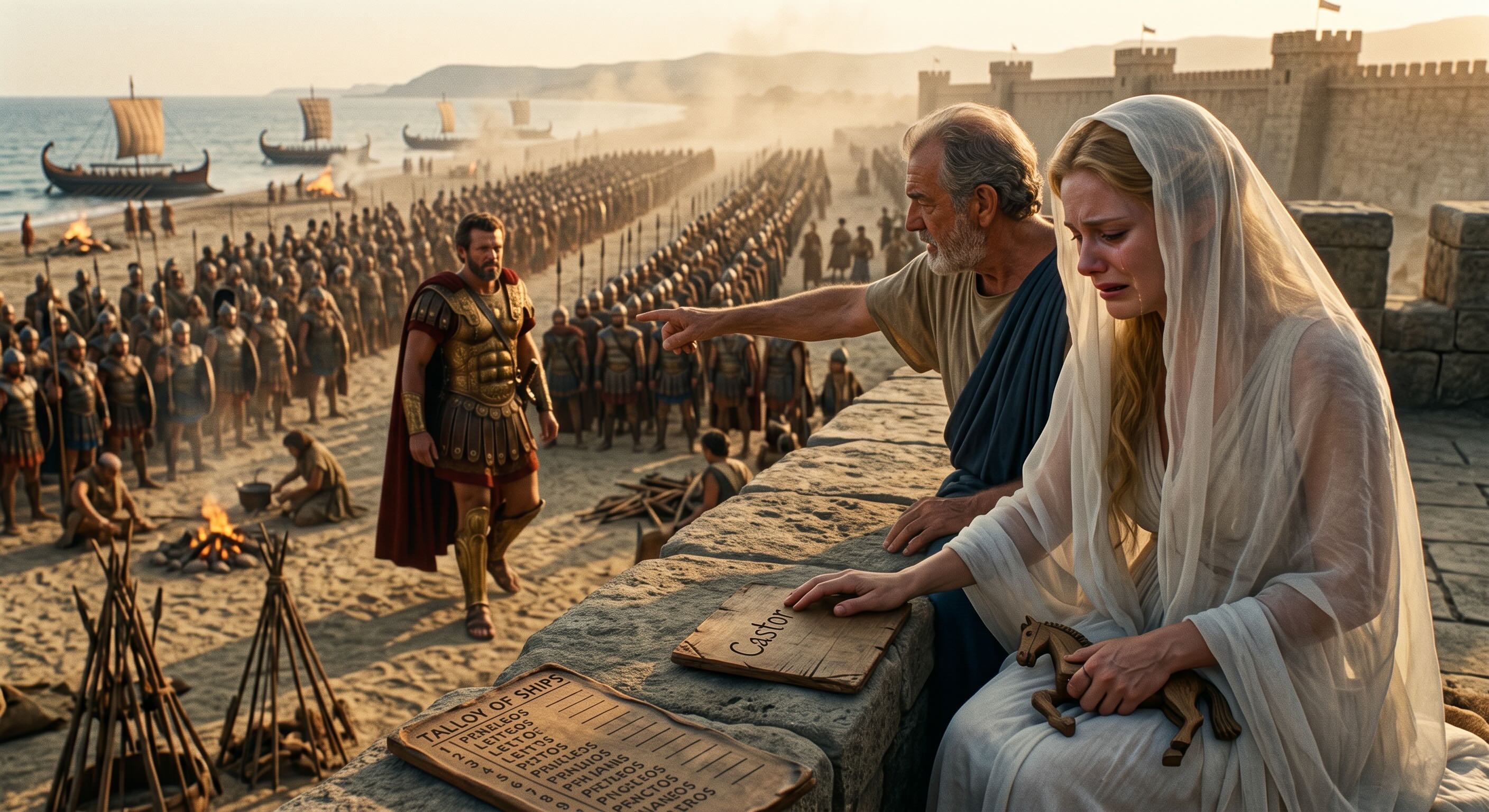
Paris and Menelaus are about to duel — winner takes Helen, the war is over, everyone can go home. Old King Priam, watching from the wall of Troy with his council of elders, sends for Helen and asks her to sit beside him. He wants her to look down at the Greek army arrayed below and tell him who's who. It's the first time in the poem we actually see Helen. She arrives in tears, wrapped in a white veil, and Priam — remarkably, given that this whole war exists because of her — is gentle with her. He tells her she isn't to blame; the gods are responsible, not her. Then he starts pointing.
Who's that one, he asks, the impressive man, broad-shouldered, clearly a king? That's Agamemnon, Helen says, my husband's brother, a fine king and a strong spearman, and once — shamelessly, to her own regret — my kinsman. Who's the shorter one, moving through the ranks like a ram through a flock? Odysseus, she says — clever, resourceful, trained in every kind of craft. She names Ajax, huge and steady, a wall in human form.
And then, scanning the field for her own brothers, Castor and Polydeuces, she doesn't find them, and wonders aloud if they've simply stayed home out of shame for her. Homer, watching from outside the scene entirely, tells us what Helen cannot know: they are already dead, buried back home in Sparta, long before the war began.
It's a strange place to put a pause. The whole plot is about to resolve. Instead, Homer gives us an old man and a woman on a wall, calmly cataloguing an enemy army together — something close to the only unguarded, tender scene in the entire poem.
The Mechanism
Look at who Homer chooses to hand the narration to. Not a neutral herald. Not one of the elders, who by their own admission can barely look at Helen without understanding, uneasily, why two nations are dying over her. He gives it to the single most compromised witness available — the woman the entire war is nominally about, married into the enemy camp, grieving, ashamed, guessing at the fate of family she can't confirm is alive. By any modern standard of who should be trusted to explain a conflict, Helen is close to the worst possible choice. She has every reason to editorialize, minimize, or perform grief she doesn't feel.
And yet she's also the only person on that wall who actually knows these men — not as silhouettes with spears, but as people she once sat across a table from. Priam doesn't ask his generals to identify the enemy captains; generals only know shapes and banners. He asks the one person who has genuinely lived among both sides. Homer seems to understand something that gets lost whenever people argue about objectivity: distance gives you a clean vantage point, but it rarely gives you understanding.
The detail about her brothers is doing quiet, careful work here too. Helen isn't just biased — she's working from incomplete information, filling gaps with hope, and Homer lets us see the gap between what she believes and what's actually true. She's not lying. She's narrating in good faith from inside a fog she doesn't know she's in. That's a sharper and more honest picture of what a witness to war usually is than either "reliable" or "propagandist" — she's someone doing her best with a compromised, partial, emotionally loaded vantage point, which is the only kind of vantage point that ever actually exists inside a war while it's happening.
The Mirror
Every conflict produces its own version of Helen on the wall, and we still haven't decided what to do with her.
-
The war correspondent who's lived in a country for a decade, married into it, buried friends there, and whose reporting is richer and more specific than any parachuted-in journalist's — and who gets accused of having "gone native" the moment their sympathy shows.
-
The defector or the whistleblower — the former true believer who can explain a regime or a company's inner workings with a clarity no outsider could match, precisely because they helped build the thing they're now describing. Testimony everyone wants and nobody fully trusts, for the same reason.
-
The child of divorced parents, dragged onto the metaphorical wall by both households, asked from an early age to explain one parent's behavior to the other, punished a little whichever way they answer.
Modern journalism has mostly resolved this tension by pretending it doesn't exist — by treating distance and detachment as the price of credibility, and treating anyone with real proximity to a conflict as suspect by definition. That produces a specific, recognizable failure mode: the "both sides" piece that quotes two equally confident sources with no way to weigh either, written by someone who has never been close enough to either side to know which one is telling the truth.
Homer's version is more honest about the trade. He doesn't pretend Helen is neutral. He just recognizes that neutral was never actually on offer — and that the choice was never between a biased witness and an unbiased one. It was between a biased witness who actually knows something, and a neutral one who doesn't.
Read the series: ← Previous: The Catalogue of Ships · Next: Hector and Andromache → · All 10 posts
Post 5 of 10 in Homer Iliad


