
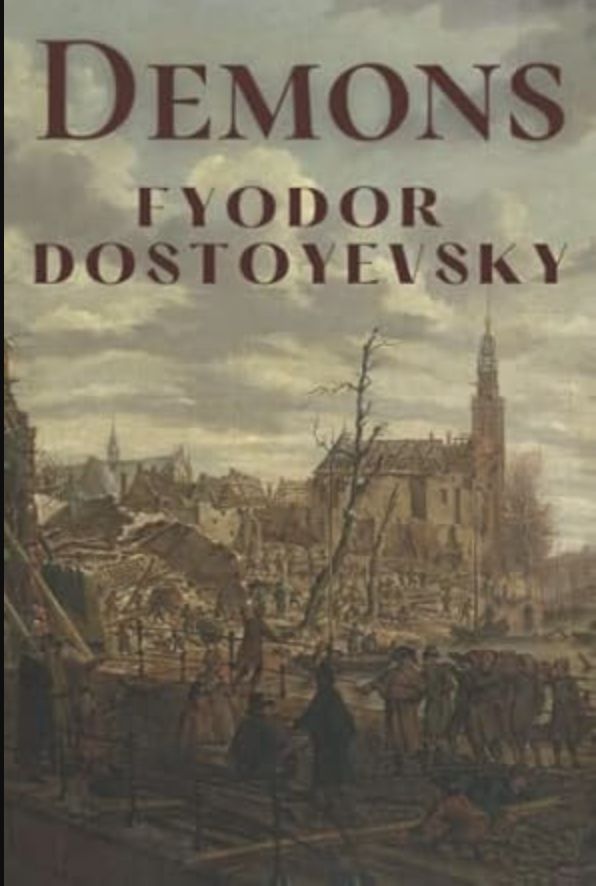
Demons (The Possessed) by Fyodor Dostoevsky
Theodoros Kafantaris
Published on December 19, 2025
1. Introduction
Welcome to the darkest, most prophetic corner of Dostoevsky's mind. Demons (1872), also published as The Possessed, is more than a novel; it is a furious, searing political and spiritual critique and a terrifyingly accurate prediction of 20th-century totalitarianism. Set in a provincial Russian town, the book chronicles the infiltration and self-destruction of a small cell of radical, nihilistic revolutionaries.
This novel is profoundly significant because it moves beyond individual guilt (Crime and Punishment) or individual goodness (The Idiot) to examine the sickness of an entire society—specifically, the dangers of abstract, Western-imported ideologies divorced from Russian reality and Christian faith. Dostoevsky demonstrates how the pursuit of an earthly utopia, fueled by intellectual pride and contempt for existing morality, inevitably leads to tyranny, violence, and self-destruction. It is a work of startling prophetic power, warning against the "devils" of ideology that possess the human spirit.
2. About the Author
Fyodor Mikhailovich Dostoevsky (1821–1881) wrote Demons during a period of intense ideological ferment in Russia, directly inspired by a real-life event: the 1869 murder of a student, Ivan Ivanov, by his fellow members in a revolutionary terrorist cell led by Sergei Nechayev. Dostoevsky saw this incident as the logical, horrifying conclusion of the liberal and nihilistic ideas that had been gaining traction among Russian intellectuals.
The novel is often classified as a pamphlet novel because of its explicit polemical purpose, yet Dostoevsky's genius prevents it from being mere propaganda. Instead, he channeled his political rage and philosophical urgency into creating characters of overwhelming psychological depth. His style here is chaotic, energetic, and highly dramatic, often using satire and dark humor to mock the intellectual vanity of the radicals while simultaneously treating their ideological despair with deadly seriousness. Demons is the most direct articulation of Dostoevsky's deeply held conservative, Orthodox Christian beliefs and his profound suspicion of atheistic rationalism and socialism.
3. Story Overview
The narrative of Demons is framed as a chronicle of local events told by an observer, Anton Lavrentievich G—v, who recounts the social and political turmoil that engulfs a provincial Russian town. The story revolves around two vastly different but equally dangerous figures: Pyotr Verkhovensky, the manipulative, cynical political operator who leads a revolutionary cell, and Nikolai Stavrogin, the mesmerizing, emotionally void aristocrat whose spiritual emptiness acts as a destructive magnet. The town is initially gripped by a wave of liberal intellectualism, spearheaded by older idealists like Stepan Verkhovensky, Pyotr's father, and the progressive governor von Lembke. However, the narrative rapidly shifts as Pyotr and Stavrogin arrive. Pyotr uses gossip, political theater, and manipulation to stir up confusion, exploiting the vanity of the local intelligentsia to recruit members for his secret cell, which he intends to use for a massive, fabricated political uprising.
Parallel to this political plot is the personal story of Stavrogin, whose mysterious past and amoral charisma draw others into his orbit. He is the true "demon" of the novel—a man devoid of faith, conscience, or purpose, who experiments with both debauchery and revolutionary ideas out of sheer boredom. His relationships with the proud Liza Tushina, the devoted Dasha, and the former serf Marya Lebyadkina (whom he secretly married as a cruel joke) highlight his capacity for destruction. Meanwhile, the revolutionary cell includes a cast of fanatics and dupes: the intellectual Shigalyov, who proposes a system of total control; the suicidal Kirillov, who believes in the necessity of self-will through suicide; and the repentant Shatov, who has returned to faith in Russia and Christ. These characters embody the ideological extremes of the era, and their interactions create a dense web of philosophical debate and psychological tension.
The central action escalates when the cell, following Pyotr's ruthless logic, decides it needs to "cement the group with blood." They target Shatov, who has renounced their nihilism and intends to confess their plans to the authorities. The conspirators, led by Pyotr, brutally murder Shatov to ensure loyalty through shared guilt. This act is the sickening climax of their ideology—a theoretical concept of revolutionary purity manifesting in a senseless, individual atrocity. Following the murder, the entire revolutionary plot immediately collapses into panic, recrimination, and self-destruction. Pyotr flees the country, leaving a wake of chaos: suicides, arson, and the exposure of the conspiracy. The novel concludes with the inevitable downfall of the revolutionaries and the devastating spiritual collapse of Stavrogin, whose profound alienation leads to a horrific final act—his suicide. The entire episode serves as a parable of how abstract revolutionary ideals, once put into practice without moral foundation, lead only to madness and destruction.
4. Key Takeaways
- The Danger of Ideological Possession: The "demons" are not literal spirits, but the abstract, radical ideas (nihilism, atheism, utilitarianism) that possess the human soul, leading people to value abstract systems over actual human life.
- The Link Between Spiritual Void and Political Violence: Dostoevsky argues that when the individual loses faith in God and eternal truth (as exemplified by Stavrogin's emptiness), the resulting moral vacuum is inevitably filled by destructive political ideologies (as exemplified by Pyotr's manipulation).
- The Inevitable Tyranny of Revolution: The novel prophetically demonstrates how revolutionary cells, even when formed to fight tyranny, quickly become internal dictatorships where the quest for power and absolute control trumps the initial idealistic goals.
- The Psychology of the Manipulator: Pyotr Verkhovensky stands as one of literature's most chillingly accurate depictions of the modern political operative who uses psychological manipulation and manufactured chaos to achieve power.
5. Why This Book Is a Must Read
Demons is Dostoevsky's dark masterpiece, essential for any reader seeking to understand the devastating intellectual and political currents of the last two centuries. It is a work of prophecy, foretelling the totalitarian purges, the moral emptiness of political violence, and the spiritual bankruptcy of pure nihilism. Though challenging due to its intricate plot and dense ideological arguments, its urgency is undeniable. For its incredible psychological portraits, its satirical brilliance, and its timeless warning about the dangers of being possessed by absolute ideas, Demons is a vital, unforgettable contribution to the '100 Books You Must Read' list.


