
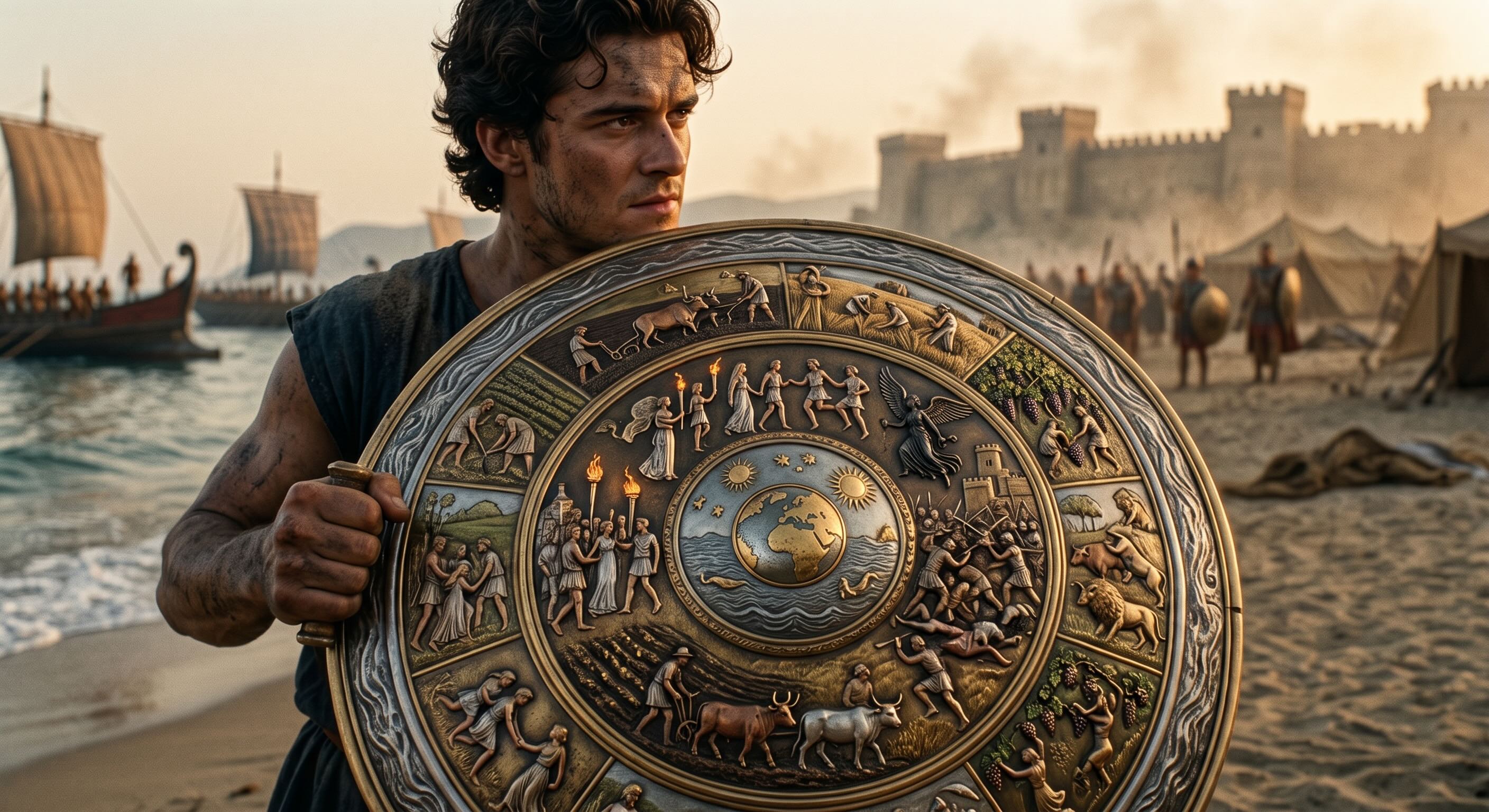
The Scene
Achilles has no armor. Patroclus died wearing it, and Hector stripped it from his body as a trophy — so when Achilles finally decides to return to the war and kill Hector, he has nothing to fight in. His mother Thetis goes to ask a favor of Hephaestus, the god of the forge: build her son a new set, and quickly, because he has almost no time left. Hephaestus agrees. And then, instead of describing a breastplate or a helmet, Homer spends over a hundred and thirty lines — one of the longest single descriptions in the entire poem — telling us exactly what the god puts on the shield.
It is not scenes of war. Or rather, it is not only that. Hephaestus forges the earth, the sky, the sea, the sun, the moon, and the constellations onto the shield's face, and then, ringed around them, two cities. In one, a wedding procession moves through the streets by torchlight, the wedding-song rising, young men dancing; nearby, in the same city's marketplace, a crowd has gathered around two men arguing over a killing — one claims to have already paid the blood-price, the other denies having received it — and the elders sit on polished stone in a sacred circle, taking turns to speak, working the dispute out loud until a judgment can be reached, while two bars of gold sit in the center as a reward for whichever elder gives the fairest ruling. The other city is under siege — an army camped outside its walls, an ambush laid, Strife and Uproar and Death personified and walking the field, dragging the dead.
Around those two cities, Hephaestus keeps going. A field being plowed, dark earth turning up gold behind the plowman, though it's carved in metal. A king's estate at harvest, reapers cutting grain in rows, boys gathering it into sheaves, an ox being slaughtered for the workers' dinner while a feast is prepared under an oak tree. A vineyard heavy with grapes, a boy playing the lyre and singing while the pickers dance around him. A herd of cattle attacked by two lions at a riverbank, dogs and herdsmen unable to stop them. A pasture. A dancing floor crowded with young men and women, holding each other's wrists, a crowd standing around them enjoying the sight, two acrobats tumbling through the middle of the dance to entertain the rest. And, at the very rim, running around the whole outer edge, the great river Ocean, holding the entire disc together.
That is the object Achilles straps to his arm to go kill Hector.
The Mechanism
The strangeness here isn't that Homer includes peaceful imagery — it's where he puts it, and when. This is, by a wide margin, the fullest picture of ordinary civilization anywhere in the Iliad: weddings, harvests, a functioning legal system, children singing, people dancing for the simple pleasure of being watched while they dance. And Homer chooses to deliver all of it embossed onto a weapon, forged in a single night, for a man about to become the most lethal and least restrained he will be in the entire poem — a man who, within a few hundred lines of putting this shield on, will kill Hector, refuse to return the body, drag it behind his chariot in circles around Patroclus's tomb for eleven straight days, and sacrifice twelve captured Trojan men alive on the funeral pyre. The shield doesn't accompany a moment of clarity or peace. It accompanies the worst thing Achilles does.
Look closely at what's actually depicted, though, and the shield isn't a fantasy of a world without conflict — it's not an idealized escape from the war Achilles is walking back into. The besieged city is right there, ambush and battle-din included, sitting only a few lines away from the wedding procession. What the shield actually offers as its alternative to war isn't the absence of dispute — it's a different way of settling one. The courtroom scene is the detail worth sitting with: two men in genuine conflict over a killing, a real disagreement about a real debt, and instead of it ending in more violence, it ends in elders taking turns speaking in a public circle until a ruling is reached. That is the precise thing Achilles is about to bypass entirely. He has no interest in a blood-price for Patroclus, no interest in an elder's judgment. He is about to become judge, jury, and executioner in one body, dragging due process out of the story completely.
And he goes to do it wearing, on his own arm, an image of the very alternative he's discarding.
Hephaestus himself matters here too, easy as he is to skip past. He's the god who is lame, unlovely among gods built for beauty and speed, who works alone at a forge making both this shield and, elsewhere in the mythology, the weapons and traps of the gods' pettier conflicts. He is craft itself, indifferent to which purpose the craft serves — the same hands that hammer out a wedding dance also hammer out a battle line. The shield doesn't resolve that tension. It just holds both things at once, peace and violence forged by the same fire, worn by the same arm, on the same night.
The Mirror
Watch what gets built, and unveiled, in the weeks right before or during the worst of something, and you'll see the shield's logic running constantly, usually with none of its self-awareness.
-
The 1939 New York World's Fair opened under the banner "The World of Tomorrow," with GM's Futurama exhibit walking visitors through a gleaming, traffic-free model city of 1960 — elevated highways, tower cities, a fully automated future — while, that same year, Germany invaded Poland and the fair's own Czechoslovak and Polish pavilions were left representing countries that no longer controlled their own governments by the time the fair closed. American wartime advertising ran the same play at scale a few years later: magazine ads through the early 1940s, printed alongside casualty lists and rationing notices, sold women on the dream kitchen and the chrome-bumper sedan waiting for them the moment the war ended.
-
Tech companies build gleaming render after gleaming render of connected, abundant, friction-free human futures — cities of sensors, instant delivery, infinite information — funded in large part by attention-harvesting business models and labor practices that look nothing like the utopia in the pitch deck. Jeff Bezos funds a ten-thousand-year clock built into a mountain, a monument to patience and long-term thinking, while the company that made him wealthy enough to build it runs on same-day delivery and next-quarter earnings calls.
None of this is hypocrisy exactly, or not only that — it's the same instinct Hephaestus is working from: when you're closest to the machinery of conflict, you often produce the most detailed, most tender vision of what peace would actually look like, because you can see with unusual clarity everything the conflict is costing.
The most direct modern echo of the shield, though, isn't cynical at all. Architects and city planners in Ukraine have spent parts of the current war drafting detailed reconstruction plans for bombed cities — rebuilt public squares, new housing blocks, restored infrastructure — not after the war ends, but during it, sometimes for buildings still standing that may not survive the month. That isn't propaganda and it isn't denial.
It's the same act Hephaestus performs on the shield: holding the image of the wedding and the courtroom and the harvest firmly in view precisely because the siege is still happening outside the walls, on the reasonable, hard-won belief that you have to keep picturing the peace in specific, livable detail or you risk losing the ability to build it once the fighting actually stops.
Read the series: ← Previous: The Death of Patroclus · Next: Achilles and Priam Share a Meal → · All 10 posts
Post 9 of 10 in Homer Iliad