
The Scene
Achilles never goes back to the war for Agamemnon. He goes back for a corpse.
By this point, the Greeks are being pushed back to the ships and burning, and Patroclus — Achilles' closest companion, closer to him than anyone else in the poem, closer even than the language of "friend" quite covers — begs to be allowed to lead the Myrmidons into battle wearing Achilles' own armor, just to scare the Trojans back from the fire. Achilles agrees, but with one condition, stated plainly: drive them from the ships, then stop. Don't chase them all the way to Troy.
Patroclus doesn't stop. Flushed with success, he pushes the rout all the way to the walls of the city, and Homer tells us outright that this is the beginning of his death. Apollo himself intervenes, striking the armor from Patroclus's back and stunning him; a minor Trojan spearman wounds him from behind; and only then does Hector step in to deliver the killing blow — and even Hector, taunting the dying man, gets to claim less credit for the kill than the god who set it up. Patroclus's last words are a prophecy of his own: that Hector himself doesn't have long to live either.
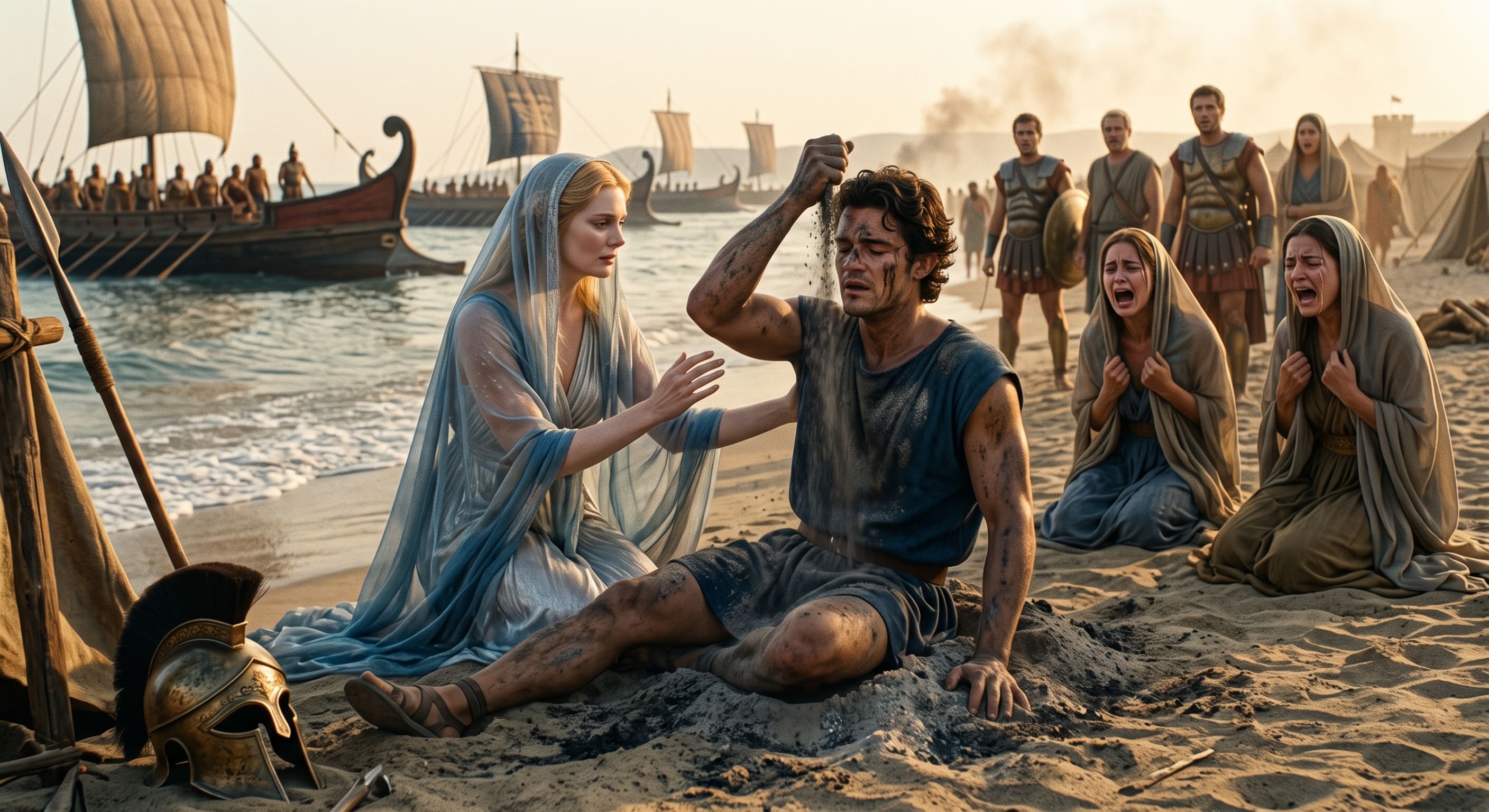
The news reaches Achilles by way of Antilochus, who can barely bring himself to say it. Achilles' response isn't restrained. He collapses, grabs handfuls of ash and pours them over his own head and face, tears at his hair, and lies in the dirt, disfiguring himself, while the women of the camp scream around him. His mother, the sea-goddess Thetis, hears his cry rise up from the shore all the way down in the depths of the ocean and comes up to hold him. He tells her flatly that he no longer wants to live, unless he can kill Hector first — and she reminds him, gently, that his own death is fated to follow close behind Hector's.
He says he doesn't care. He refuses to eat, refuses to wash the blood and grime from his body, and says he'll do neither until Patroclus is avenged.
The Mechanism
Up to this point, everything Achilles has done in the poem has been legible as strategy, however furious. Withdrawing from the war at the start was a calculated move — an attempt to make Agamemnon feel his absence and restore what was taken from him. Even refusing the embassy was, in its own way, a negotiating position: a man protecting the last thing he had left, his sense of his own worth. You could disagree with Achilles across the first two-thirds of the poem, but you could always follow his logic. He was playing a status game, and playing it consistently.
Patroclus's death breaks that logic entirely, not by escalating it but by making it irrelevant. Achilles doesn't return to the war to restore his honor, reclaim Briseis, or collect on Agamemnon's debt — all of that machinery simply stops mattering. He says outright that he no longer cares whether he dies immediately after Hector does. The entire economy of kleos that the earlier books ran on, the careful accounting of who owes whom what, evaporates. He isn't fighting for a name anymore. He's not calculating anything. What's left, once you strip away the strategy, isn't a bigger version of his old wrath — it's something with no negotiating position at all, because there's nothing left to negotiate for.
That's the real shift this scene marks, and it's why the poem spends so much time on the funeral rites that follow rather than rushing to the final duel: grief here doesn't sit alongside Achilles' old priorities, it replaces them. He holds Patroclus's funeral games with an open-handed generosity that looks almost nothing like the man who once nearly killed Agamemnon over a single captive woman. And in the same stretch of the poem, he does the opposite too — drags Hector's body behind his chariot day after day, sacrifices twelve Trojan captives on Patroclus's pyre, acts with a cruelty that even the gods watching from Olympus find excessive. Both the generosity and the cruelty come from the same place: a man whose old operating system — status, honor, proportion, what's owed to whom — has simply been switched off.
Grief hasn't made Achilles angrier. It's made him someone who isn't running the same program anymore.
The Mirror
Watch what actually happens to people after a death that reaches them the way Patroclus's reaches Achilles, and you'll recognize the same reorganization, usually stripped of anything as clean as ash and mourning cries.
-
The person who quits the job they'd spent a decade climbing toward, after losing a parent or a partner or a close friend — not out of any plan, but because the promotion they were chasing six weeks ago has simply stopped registering as real.
-
The colleague who throws themselves into work with a kind of ferocity that looks like ambition from the outside but is really the opposite — not caring about the career at all, just needing somewhere to put the hours that used to be spent with someone who no longer exists.
-
The parent who becomes a tireless advocate — a foundation-founder, a campaigner for a cause tied directly to how they lost someone. A grief that never stopped being grief, just found a shape big enough to hold it and pointed it somewhere.
And it's worth noticing what modern life mostly doesn't give people, compared to what Achilles gets. He's granted an entire cultural apparatus for total, extravagant, public collapse — ash on the face, communal wailing, funeral games that run for days, a goddess mother who rises from the sea to sit with him in the dirt. Bereavement leave in most companies runs three to five days, after which the expectation, spoken or not, is that you'll be back at your desk, composed, deliverables on schedule. We've largely decided that adult grief should be private, brief, and tidy — dealt with on your own time, ideally invisibly. Homer's culture assumed the opposite: that a loss of this size should stop everything visibly, for everyone, for as long as it takes. A great deal of what gets diagnosed today as burnout, or unexplained rage, or someone suddenly "not being themselves" at work, is grief that never got its funeral games — sorrow that had nowhere sanctioned to go, so it went sideways instead, into exhaustion, or short temper, or a cruelty the person themselves doesn't fully recognize in the mirror.
Achilles doesn't get better by being talked out of his grief or offered a better deal, the way the embassy tried and failed to do with his anger. He gets to feel the whole scale of it — ash, refusal to eat, the body dragged in the dust, the pyre — and only on the other side of all that excess does something like his old self begin to return, at the very end of the poem, when he sits across from Priam and, astonishingly, weeps together with the father of the man who killed his friend.
The poem's answer to catastrophic loss was never composure. It was letting the grief be as large as the thing that caused it, and trusting that a person eventually comes back through it, not around it.
This post touches on grief and loss — if any of this lands close to home, it's worth talking to someone you trust or a grief counselor rather than carrying it alone.
Read the series: ← Previous: The Embassy to Achilles · Next: The Shield of Achilles → · All 10 posts
Post 8 of 10 in Homer Iliad