
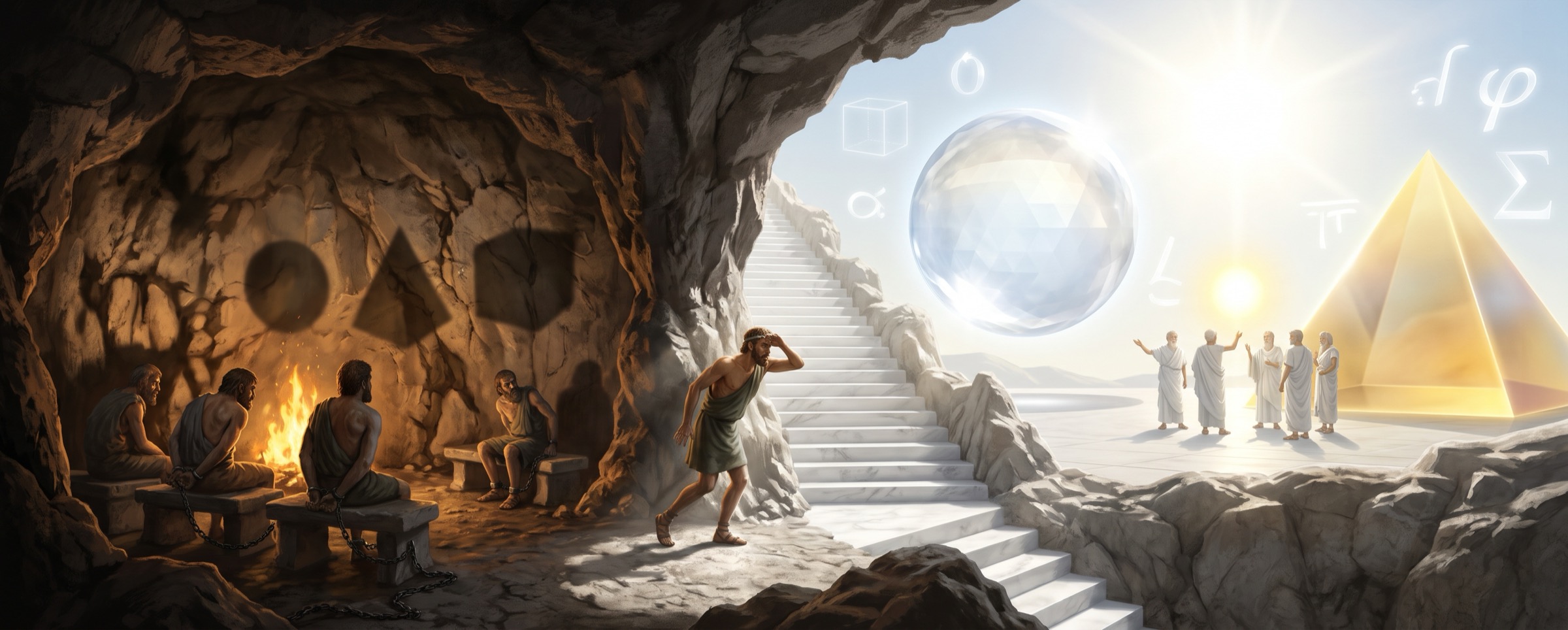
Most people spend their entire lives staring at shadows on a wall.
In Episode 5, we saw Socrates challenge the assumptions of his peers. Following his execution, his greatest student, Plato (~428 – ~348 BCE), took that challenge to an extraordinary level.
Plato realized that if human senses are easily fooled, we need a standard of truth that sits far above physical perception.
He proposed that the world we see around us is merely an imperfect copy of a higher, flawless reality: The World of Forms.
Here is the story of the founder of the Academy—and how to apply his frameworks today.
Who Was Plato?
Born into an aristocratic Athenian family, Plato turned away from politics after the state executed his mentor, Socrates.
Instead, he founded The Academy outside Athens—widely considered the first institution of higher learning in the Western world. Above its entrance, legend holds, was carved the motto: "Let no one ignorant of geometry enter here."
Plato wrote entirely in philosophical dialogues, using Socrates as his primary character. Through masterpieces like The Republic, Phaedo, and Symposium, he laid the structural foundations for Western ethics, metaphysics, and political science.
As 20th-century philosopher A.N. Whitehead famously remarked: "The safest general characterization of the European philosophical tradition is that it consists of a series of footnotes to Plato."
The 3 Mental Models of Plato
1. The Theory of Forms (Eidos)
Look at a physical circle drawn on paper. It is never mathematically perfect—the lines are uneven, the ink bleeds. Yet, your mind understands the concept of a perfect circle.
Plato argued that perfect, eternal concepts (Forms) exist in an intelligible realm outside physical space and time. Physical objects are merely flawed, temporary shadows of these universal archetypes.
The breakthrough: Distinguish between the physical instance (imperfect execution) and the underlying blueprint (ideal architecture).
2. The Allegory of the Cave
Imagine prisoners chained inside a dark cave since birth, forced to face a blank wall. Behind them, a fire burns, and handlers pass shapes along a walkway. The prisoners see only shadows cast on the wall and believe those shadows are total reality.
If a prisoner escapes into the sunlight outside, his eyes will hurt, but he will eventually see real trees, stars, and the Sun itself. If he returns to free the others, they will mock him or try to kill him because he threatens their comfortable illusions.
His insight: Unexamined experience is just shadow-play. Awakening requires painful intellectual effort to see underlying structural mechanics.
3. The Tripartite Soul & Internal Governance
In The Republic, Plato divides the human psyche (and human society) into three distinct drivers:
- Reason (Logos): The rational driver seeking truth and wisdom.
- Spirit (Thumos): The emotional driver seeking honor, pride, and agency.
- Appetite (Eros): The primal driver seeking physical desires, money, and comfort.
A chaotic life or failing organization occurs when Appetite or Spirit takes the wheel. Harmony occurs only when Reason acts as the charioteer governing both horses.
His breakthrough: Systemic success requires rational governance over reactive emotion and immediate craving.
How to Apply Plato Today
1. Design for the "Form," Not Just the Prototype
In software, architecture, or business strategy, don't get bogged down by messy, early-stage operational friction. Define the Ideal Form first: If this system were operating with zero friction and perfect elegance, what would its core architecture look like? Build toward the ideal, rather than tweaking flawed legacy shadows.
2. Break Free from Algorithmic Shadows
Modern feeds, media narratives, and outrage cycles are the modern Cave's shadow wall. They show you carefully crafted, flickering distortions of reality designed to keep you chained. Stop analyzing the shadows; step back, look at the incentive structures, and evaluate raw data.
3. Act as the Charioteer of Your Routine
Audit your daily operations using the Tripartite framework: Are your daily choices driven by Reason (long-term strategy and health), Spirit (ego, status-seeking, arguments), or Appetite (dopamine scrolling, short-term comfort)? Put Reason back in charge of the chariot.
Summary
- The Theory of Forms: Separate temporary execution from the ideal blueprint.
- The Cave: Recognize that surface narratives are often just crafted shadows.
- The Tripartite Soul: Use Reason to govern your ego and immediate desires.
Episode 6 of The Compass of Philosophers series.
If you found this valuable:
- Bookmark this post to revisit these frameworks later.
- Follow for Episode 7: Aristotle and the Golden Mean.
What is one "shadow" (a distraction or superficial narrative) you need to step away from in your work right now? Let's discuss below.